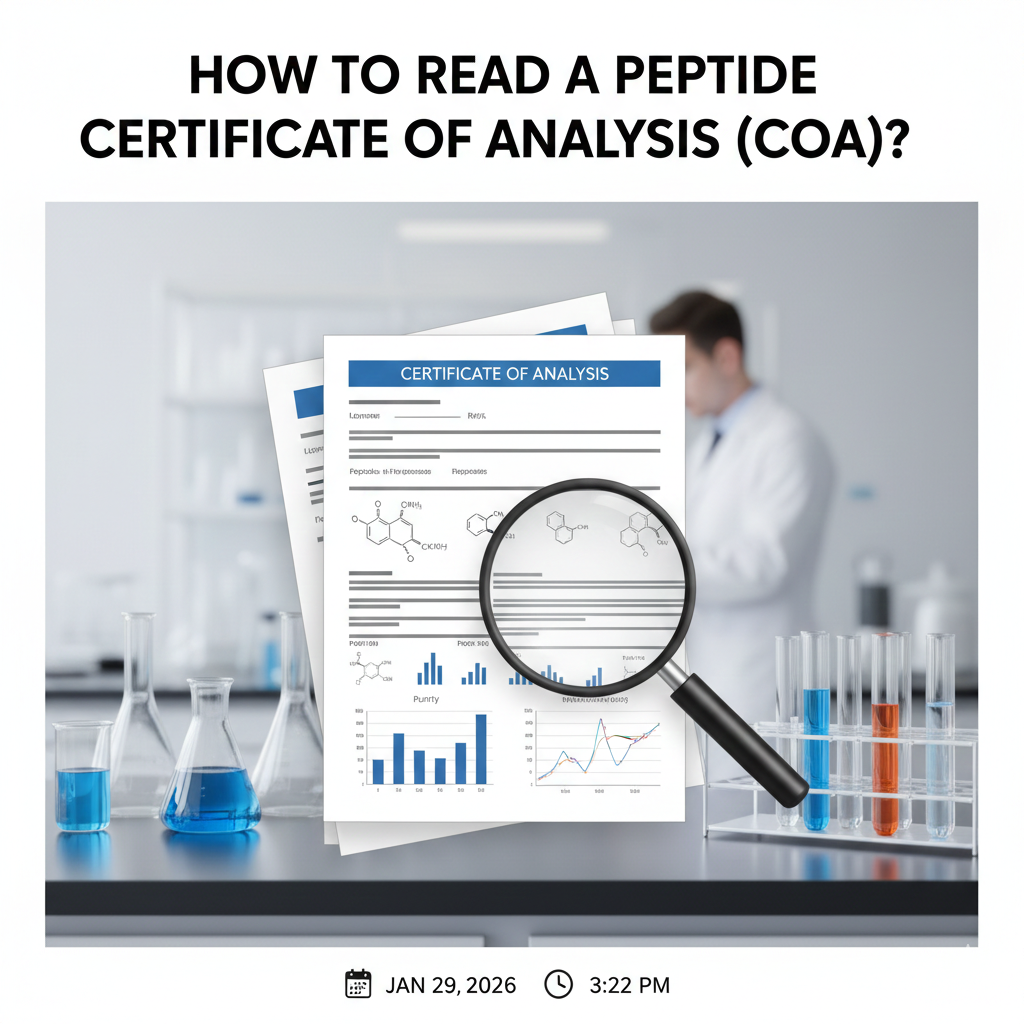
When you receive a peptide for research purposes, the Certificate of Analysis is the single most important document that accompanies it. Yet many researchers struggle to interpret what they're looking at when they open a COA for the first time. Understanding how to read a peptide COA isn't just about checking boxes on a quality control form. It's about ensuring the integrity of your research, protecting your investment, learning how to calculate peptide concentration accurately, and avoiding the costly mistakes that come from working with substandard or misidentified compounds.
A Certificate of Analysis serves as your primary quality assurance tool, especially for research-grade peptides that fall outside pharmaceutical regulations. Because these materials aren't subject to the same oversight as FDA-approved drugs, the burden of verification sits squarely with you as the researcher. A legitimate COA must answer three fundamental questions that determine whether your peptide is suitable for experimental use, guides your reconstitution strategy, and helps you maintain peptide stability throughout your experiments.
Table of Contents
-
What Is a Certificate of Analysis and Why Third Party Testing Matters
-
Understanding HPLC Purity: What Does 98 Percent Peptide Purity Actually Mean
-
Mass Spectrometry Identity Verification: Confirming You Have the Right Peptide Sequence
-
Net Peptide Content vs HPLC Purity: Understanding the Complete Picture
-
How to Calculate Peptide Concentration Using Your COA
-
Batch Numbers, Testing Dates, and Storage Conditions: The Essential Details
-
How to Reconstitute Peptides Based on COA Information
-
Peptide Stability and Degradation: What Your COA Can't Tell You
-
Red Flags: How to Spot Fake Peptide COAs and Avoid Costly Mistakes
-
Putting It All Together: Using Your COA to Ensure Research Quality
-
Frequently Asked Questions About Peptide Certificates of Analysis
What Is a Certificate of Analysis and Why Third Party Testing Matters
Batch-Specific Documentation and Traceability
A Certificate of Analysis is a batch-specific laboratory report that documents the analytical evaluation of a peptide following synthesis. This isn't a generic document that applies to all batches of a particular peptide. Each synthesis run produces a unique batch with its own characteristics, and the COA must reflect testing performed specifically on the material you received. The batch identifier on your COA must match the vial label exactly, or the document becomes meaningless for quality verification purposes.
The Importance of Independent Third Party Testing
The most critical aspect of a trustworthy COA involves who performed the testing. Third party peptide testing eliminates the inherent conflict of interest that exists when manufacturers test their own products. Independent laboratories provide unbiased, empirical data rather than marketing claims. When evaluating peptide suppliers, one of the biggest red flags is a refusal to provide third party COAs or the inability to verify testing results through an independent laboratory's website.
Accreditation Standards and Laboratory Credentials
Credible suppliers work with accredited analytical laboratories that meet international standards such as ISO 17025. These facilities employ validated testing methods, calibrated equipment, and trained analysts who follow standardized protocols. The COA should clearly identify the testing laboratory, include accreditation details, and provide contact information that allows you to verify the document's authenticity directly with the lab.
Understanding HPLC Purity: What Does 98 Percent Peptide Purity Actually Mean
How HPLC Testing Works for Peptides
High-Performance Liquid Chromatography represents the gold standard method for quantifying peptide purity. When you see a purity value like 98.7% on a COA, this number tells you something very specific but also has important limitations you need to understand. HPLC purity reflects the proportion of your sample that consists of the target peptide relative to other peptide-related impurities that absorb ultraviolet light at 214 to 220 nanometers.
Reading HPLC Chromatograms and Understanding Peak Analysis
The testing process works by separating the target peptide from synthesis byproducts including deletion sequences, truncated fragments, and incompletely deprotected peptides. These impurities appear as additional peaks on the chromatogram that accompanies your COA. A high-purity peptide typically shows one dominant sharp peak with minimal secondary peaks. The purity percentage is calculated by comparing the area under the main peak to the total area of all peaks detected in the chromatogram.
Learning HPLC chromatogram interpretation helps you verify supplier claims rather than simply trusting reported percentages. When you examine the actual trace, look for a symmetric, narrow main peak that rises sharply and returns to baseline cleanly. Broad, tailing, or split peaks may indicate multiple peptide species or column performance issues. Secondary peaks appearing before the main peak (shorter retention time) often represent deletion sequences, while peaks after the main peak suggest incompletely deprotected or aggregated forms. Understanding how to read HPLC peaks allows you to assess the peptide impurity profile and judge whether impurities might interfere with your specific application.
The UV detection wavelength peptides are analyzed at matters for interpretation. Most peptide COAs use UV detection at 214 nm or 220 nm because the peptide bond absorbs strongly at these wavelengths, providing universal detection regardless of amino acid composition. Some COAs include dual-wavelength monitoring at both 214 nm and 280 nm, with the latter specifically detecting aromatic residues like tyrosine and tryptophan. Comparing traces at different wavelengths helps identify whether impurity peaks contain aromatic amino acids, providing clues about their chemical nature.
What HPLC Purity Does Not Measure
What many researchers misunderstand is that HPLC purity only accounts for peptide-related impurities and other UV-absorbing organic compounds. This measurement does not include water, trifluoroacetic acid salts, or other non-chromophore materials that contribute to the total weight of your lyophilized powder. This distinction becomes crucial when you need to calculate accurate molar concentrations for your experiments, which is why net peptide content represents a separate and equally important metric.
What Is a Good Purity for Peptides
For research-grade materials, peptides showing greater than 98% purity are considered excellent and suitable for quantitative assays, structural biology studies, and sensitive cell-based work. Purity levels between 95 and 97% represent standard research grade that works well for most discovery-phase applications. Anything below 95% may contain enough impurities to interfere with experimental results, particularly in assays where molecular specificity matters.
Mass Spectrometry Identity Verification: Confirming You Have the Right Peptide Sequence
Why Mass Spectrometry Is Essential Beyond HPLC
Here's something that catches many researchers off guard: a peptide can show 99% purity on HPLC but still be the wrong sequence. A peptide missing just one amino acid might appear nearly pure using chromatographic methods because the deletion sequence has similar chemical properties to the target peptide. This is exactly why mass spectrometry identity verification is non-negotiable for confirming peptide quality.
How Mass Spectrometry Confirms Peptide Identity
Mass spectrometry works by measuring the molecular weight of your peptide with high precision. A legitimate COA includes both the theoretical mass calculated from the amino acid sequence and the observed mass measured by the instrument. Common techniques include Electrospray Ionization Mass Spectrometry and Matrix-Assisted Laser Desorption Ionization Time-of-Flight Mass Spectrometry. Each approach has its strengths, but both should arrive at essentially the same molecular weight for your peptide.
Interpreting Mass Spectrometry Data and Acceptable Tolerances
When reviewing the mass spectrometry section of your COA, you should see that the observed mass matches the theoretical mass within an acceptable tolerance range. For singly charged ions, this typically means agreement within plus or minus 0.5 to 1.0 Daltons. You might notice small additions like +22 or +38 to the expected mass, which represent sodium or potassium adducts that form during the ionization process. Understanding mass spectrometry adducts explained helps you recognize these are normal artifacts of the measurement technique and don't indicate quality problems with your peptide.
When comparing MALDI-TOF versus ESI-MS peptides results, both techniques should arrive at essentially the same molecular weight for your target sequence. MALDI-TOF typically produces predominantly singly-charged ions with clear mass assignments, making interpretation straightforward. ESI-MS often generates multiply-charged ion species, requiring deconvolution to determine the actual molecular weight, but provides complementary confirmation of peptide identity. Some COAs include data from both techniques, offering dual verification that strengthens confidence in the documented molecular weight.
Identifying Problems Through Mass Spectrometry Results
Significant deviations beyond a few Daltons often signal serious issues such as incorrect synthesis, oxidation of methionine or cysteine residues, or even complete misidentification of the compound. If the molecular weight data on your COA shows poor agreement with the expected value, the peptide should not be used regardless of what the purity percentage indicates. Both identity and purity must be confirmed for the material to be research-grade.
Net Peptide Content vs HPLC Purity: Understanding the Complete Picture
The Critical Difference Between Purity and Content
One of the most frequently misunderstood aspects of peptide quality control involves the difference between HPLC purity and net peptide content. These two metrics tell you fundamentally different things about what's actually in your vial, and confusing them leads to significant errors in experimental design and data interpretation.
What Net Peptide Content Actually Measures
Net peptide content measures the percentage of the vial's total weight that consists of actual peptide material, excluding water, trifluoroacetic acid salts, and other counter ions. After synthesis and purification, peptides exist as their trifluoroacetate salts because TFA is used during cleavage and HPLC purification. While free TFA gets removed during workup and freeze-drying, TFA anions remain associated with each positively charged amino functionality in your peptide.
How to Calculate Peptide Concentration Correctly
The practical impact of this becomes clear when you calculate concentrations for your experiments. A peptide might show 98% HPLC purity but have only 70% net peptide content. If you assume you're working with pure peptide and calculate your molarity based on the gross weight, your actual concentration could be off by 30% or more. This error compounds across every experiment, potentially invalidating months of research data.
Why Some Peptides Have Lower Net Peptide Content
Net peptide content is typically determined through amino acid analysis or elemental analysis that quantifies the nitrogen content in your sample. Peptides containing a large proportion of basic amino acids, especially arginine, naturally have lower net peptide content even when they're extremely pure, because each arginine carries its own TFA counter ion. This isn't a quality defect but rather a predictable consequence of the peptide's chemical composition. Legitimate suppliers clearly report both HPLC purity and net peptide content on their COAs, allowing you to make accurate calculations for your specific application.
How to Calculate Peptide Concentration Using Your COA
The Complete Formula for Accurate Peptide Molarity
One of the most practical applications of understanding your COA involves calculating the actual peptide concentration in your stock solutions. Many researchers make critical errors by using only the gross weight listed on the vial label, which leads to significant concentration miscalculations. Learning how to calculate peptide stock solution accurately requires using three key values from your COA together with the peptide's molecular weight.
The complete formula for determining actual peptide amount is: Actual Peptide Mass (mg) = Gross Weight (mg) × Net Peptide Content (%) × HPLC Purity (%). Once you have the actual peptide mass, you can calculate molarity using this formula: Molar Amount (µmol) = [Actual Peptide Mass (mg) ÷ Molecular Weight (g/mol)] × 1000. This two-step calculation ensures you know precisely how much active peptide you're working with rather than making assumptions based on the vial's gross weight.
Step-by-Step Peptide Concentration Calculator Example
Let's work through a real-world example to demonstrate how to calculate peptide molarity from COA data. Suppose you receive a peptide with these specifications: gross weight of 5.0 mg listed on the vial, net peptide content of 85% from amino acid analysis, HPLC purity of 98.7%, and a molecular weight of 1060.5 g/mol. First, calculate the actual peptide mass: 5.0 mg × 0.85 × 0.987 = 4.195 mg of actual peptide. Next, convert to moles: 4.195 mg ÷ 1060.5 g/mol × 1000 = 3.956 µmol of peptide.
If you dissolved this entire amount in 1.0 mL of buffer, your stock solution concentration would be 3.956 mM, not the 4.716 mM you would calculate using only gross weight. That's a 16% error that compounds through every dilution and experiment you perform. This demonstrates why understanding the difference between gross weight versus net weight peptide calculations is essential for reproducible research and why your COA provides both purity metrics.
Common Peptide Dosing Calculation Errors to Avoid
The most frequent mistake researchers make involves using molecular weight alone without accounting for TFA salt peptide weight contributions. When you see a peptide advertised as having a certain molecular weight, that number reflects only the peptide chain itself, not the counter ions associated with basic residues. Your COA's net peptide content specifically accounts for these additional masses, which is why ignoring this value can throw off your accurate peptide dosing by 20-40% in arginine-rich sequences.
Another common error occurs when researchers assume that HPLC purity alone tells them everything about concentration. Remember that a peptide showing 99% HPLC purity could still have 70% net peptide content due to water and TFA salts. Both numbers work together to give you the true picture of what's in your vial. Always use the complete formula incorporating both metrics rather than shortcuts that seem simpler but produce inaccurate results.
Batch Numbers, Testing Dates, and Storage Conditions: The Essential Details
Verifying Batch Number Traceability
Beyond the analytical data, several administrative details on your COA deserve careful attention because they directly impact whether you can trust and properly use your peptide. The batch or lot number creates traceability between the physical vial in your hands and the testing results on paper. This number should be printed clearly on both the COA and your product label. Any mismatch immediately invalidates the certificate.
Understanding Testing Date Significance
Testing dates tell you how recently the analysis was performed. Peptides are relatively stable when properly stored, but they can degrade over time, especially if exposed to moisture, light, or elevated temperatures. A COA issued more than six months before your purchase date raises questions about whether the material has been sitting in inventory too long. Fresh testing demonstrates that the supplier maintains active quality control rather than relying on outdated documentation.
Following Storage and Handling Instructions
Storage and handling instructions provide critical information for maintaining peptide quality after you receive it. Most research-grade peptides should be stored at minus 20 degrees Celsius in a dry environment, protected from light and moisture. The COA should specify these peptide storage conditions clearly and might include reconstitution recommendations based on the peptide's solubility characteristics and salt form. Following these guidelines ensures your material remains stable and functional throughout your experimental timeline.
Understanding how long peptides last under proper storage conditions helps you plan experiments and assess whether your material still matches COA specifications. Lyophilized peptides stored correctly at minus 20 degrees Celsius in desiccated conditions typically maintain their quality for one to two years. However, peptide shelf life varies significantly based on amino acid composition. Sequences containing methionine, cysteine, tryptophan, asparagine, or glutamine show greater susceptibility to degradation and may have shorter usable periods even under ideal storage.
Peptide Stability Testing and Shelf Life Considerations
Once you reconstitute a peptide, stability becomes a much more pressing concern than with the lyophilized powder. Reconstituted peptide solutions generally remain stable for only one to four weeks when stored at minus 20 degrees Celsius, and even less time at 4 degrees Celsius. The exact timeframe depends heavily on the buffer system, pH, and amino acid sequence. Your COA provides the baseline quality at the time of synthesis, but it cannot predict how your specific storage and handling will affect long-term peptide stability.
Freeze-thaw cycles represent one of the most damaging practices for reconstituted peptides, causing aggregation and degradation that your original COA cannot account for. Each time you thaw and refreeze a peptide solution, you risk compromising its integrity. Best practice involves aliquoting your stock solution into single-use amounts immediately after reconstitution, then storing these aliquots at minus 20 or minus 80 degrees Celsius. This approach minimizes repeated freeze-thaw exposure while maintaining the quality your COA originally documented.
Additional Quality Control Information
Some COAs include additional information such as the appearance of the lyophilized material, molecular weight data from multiple analytical techniques, and results from specialized tests like endotoxin assays or residual solvent analysis. While not every peptide requires this level of documentation for research purposes, their presence indicates thorough quality control practices and attention to detail that generally correlates with higher overall product quality.
How to Reconstitute Peptides Based on COA Information
Understanding Peptide Solubility Issues Before Reconstitution
Learning how to reconstitute peptides correctly begins with understanding the information your COA provides about the peptide's chemical properties. The salt form specified on your COA, typically trifluoroacetate, influences solubility behavior and should guide your choice of reconstitution buffer. Some researchers encounter peptide solubility issues when they ignore the relationship between their peptide's net charge, hydrophobicity, and the appropriate solvent system. Your COA's amino acid sequence and purity data provide clues about which reconstitution approach will work best.
Before attempting to dissolve peptides, examine the sequence for hydrophobic regions and charged residues. Peptides with many hydrophobic amino acids like leucine, isoleucine, phenylalanine, and tryptophan may resist aqueous solutions and require organic cosolvents. Conversely, peptides rich in charged residues usually dissolve readily in water or buffered solutions. The COA doesn't explicitly tell you how to reconstitute your specific peptide, but understanding its purity and composition allows you to make informed decisions about the best approach.
How to Dissolve Peptides: Practical Reconstitution Strategies
The general rule for how to dissolve peptides starts with using the minimum volume of the appropriate solvent to achieve your target concentration, calculated using the formulas from the previous section based on your COA data. Always add solvent to the peptide powder, never the reverse, and avoid vigorous vortexing which can cause foaming and peptide degradation. Gentle mixing, brief bath sonication, or allowing the peptide to hydrate at room temperature for several minutes often provides better results than aggressive agitation.
For hydrophobic peptide solubility challenges, a stepwise approach works best. First, attempt reconstitution in sterile water or your target buffer. If the peptide doesn't fully dissolve within 10 minutes of gentle mixing, add a small amount of DMSO or acetonitrile (typically 10-20% of final volume) to solubilize the peptide, then dilute with your aqueous buffer to the desired concentration. Your COA's purity data becomes especially important here because impurities can interfere with solubility and make reconstitution more difficult than expected from the sequence alone.
Peptide Reconstitution Buffer Selection
Choosing the right peptide reconstitution buffer depends on your experimental requirements and the peptide's characteristics revealed in your COA. Acidic peptides (those with more glutamate and aspartate residues) generally dissolve best in basic solutions like 0.1 M sodium bicarbonate or dilute ammonium hydroxide. Basic peptides (rich in arginine, lysine, and histidine) prefer acidic solutions such as 0.1% acetic acid or 0.1% TFA. Neutral peptides often dissolve well in sterile water, PBS, or HEPES buffer.
The COA's storage recommendations sometimes include reconstitution guidance, but even when absent, you can infer appropriate conditions from the analytical data provided. Pay attention to the counterion form listed on the COA. Peptides supplied as trifluoroacetate salts may have different solubility profiles than those supplied as acetate or hydrochloride salts. Understanding these nuances helps you avoid the frustrating experience of repeatedly failing to get your peptide into solution, which wastes valuable research material and time.
Peptide Stability and Degradation: What Your COA Can't Tell You
How to Tell If Peptide Is Degraded After Storage
Your Certificate of Analysis documents peptide quality at one specific point in time, but it cannot predict or detect degradation that occurs during storage in your laboratory. Learning how to tell if peptide is degraded becomes essential for researchers who store materials long-term or work with peptides susceptible to chemical instability. Several observable changes signal that your peptide may no longer match its original COA specifications and could compromise experimental results.
Visual inspection provides the first clue about potential peptide degradation signs. Fresh lyophilized peptides typically appear as white or off-white fluffy powders. A change to yellow, brown, or tan coloration often indicates oxidation, particularly in peptides containing methionine, cysteine, or tryptophan. Clumping, caking, or a change from powdery to gummy texture suggests moisture exposure, which accelerates degradation. If your peptide's appearance differs significantly from the description on the original COA, consider the material potentially compromised.
Reconstitution behavior also reveals degradation. A peptide that previously dissolved easily but now shows reduced solubility, forms precipitates, or produces cloudy solutions has likely undergone changes that affect its chemical properties. Unusual odors, particularly a strong acetic acid smell beyond what's normal for TFA salts, can indicate bacterial contamination or chemical breakdown. When you observe any of these peptide degradation signs, the safest approach involves ordering fresh material rather than risking experiments with questionable reagents.
Understanding Peptide Oxidation and Common Degradation Pathways
Methionine oxidation peptides represent one of the most common forms of degradation that researchers encounter, especially with peptides stored improperly or past their optimal shelf life. Methionine residues are highly susceptible to oxidation by atmospheric oxygen, hydrogen peroxide, and other oxidizing agents, converting to methionine sulfoxide. This modification adds 16 Daltons to the molecular weight and can significantly alter peptide activity and binding properties. Your original COA showed the unoxidized form, but if degradation occurred during storage, your actual material no longer matches those specifications.
Cysteine peptide storage presents similar challenges because free cysteine residues can form disulfide bonds with other cysteine-containing peptides in solution, creating unwanted dimers and aggregates. This oxidative dimerization changes the molecular weight and can produce insoluble precipitates. Peptides with free cysteines should ideally be stored under nitrogen or argon atmosphere and reconstituted in degassed buffers containing reducing agents like DTT or TCEP when appropriate for your application. The COA cannot warn you if subsequent oxidation has occurred.
Asparagine and glutamine residues undergo deamidation over time, converting to aspartic acid and glutamic acid respectively. This degradation pathway occurs more rapidly at elevated pH and temperature, particularly in solution. Tryptophan photodegradation happens when peptides are exposed to UV or intense visible light. Each of these modifications changes the peptide's mass, charge, and potentially its biological activity, meaning your degraded peptide no longer reflects the COA's documented purity and composition.
Monitoring Research Reagent Quality Control Over Time
Implementing proper research reagent quality control practices ensures your peptides continue to meet specifications between the time you receive the COA and when you actually use the material in experiments. Consider ordering peptide validation for publication quality work, especially for studies you plan to submit to high-impact journals. Some facilities offer reanalysis services that generate updated COAs for stored peptides, confirming whether materials still match original specifications.
For critical experiments requiring maximum reproducible research peptides performance, using fresh materials with recent COA dates provides the greatest confidence. The cost of replacing potentially degraded peptides is minimal compared to the expense of conducting entire studies with compromised reagents that produce irreproducible results. Many publication failures and conflicting literature reports stem from using degraded peptides that no longer match their documented specifications, highlighting why attention to peptide quality assurance research principles matters throughout the entire experimental timeline.
When batch-to-batch variability concerns arise, comparing COAs across multiple orders of the same peptide sequence helps identify consistency in supplier manufacturing. Significant variations in purity, observed mass, or impurity profiles between batches signal quality control problems at the supplier level. Researchers conducting long-term studies should archive COAs from every batch used and document batch numbers in laboratory notebooks, enabling troubleshooting if unexpected results occur.
Red Flags: How to Spot Fake Peptide COAs and Avoid Costly Mistakes
Recognizing Generic and Recycled COAs
The unfortunate reality is that fake or misleading Certificates of Analysis exist in the peptide marketplace, and learning to recognize them protects you from wasting time and money on substandard materials. Certain warning signs immediately identify documents that lack scientific validity and should trigger serious questions about supplier credibility.
Generic template COAs that get reused across multiple batches or products represent one of the most common deceptions. A legitimate certificate applies to one specific batch only and includes unique analytical data generated from testing that exact material. If you notice the same chromatogram appearing for supposedly different batches, or if batch numbers and dates seem inconsistent across multiple COAs from the same supplier, these patterns suggest the documents aren't authentic testing records.
Identifying Missing Critical Data
Missing analytical details constitute another major red flag. A COA that lists a purity percentage without showing the actual chromatogram provides no way to verify the claim. Similarly, mass spectrometry sections that report "pass" or "confirmed" without showing expected and observed masses lack the specificity that makes MS data meaningful. Legitimate testing laboratories provide complete analytical traces because this transparency allows independent evaluation of their work.
Verifying COA Authenticity Through Laboratory Portals
Inability to verify COAs through the testing laboratory's website should immediately raise suspicions. Reputable analytical labs maintain online portals where you can look up test results using a verification code or unique identifier from the COA. If the supplier refuses to provide this information or claims their testing is "proprietary" and can't be independently confirmed, you should assume the documentation isn't trustworthy until proven otherwise.
Putting It All Together: Using Your COA to Ensure Research Quality
Your Step-by-Step COA Review Checklist
Understanding how to read a Certificate of Analysis transforms you from a passive consumer of research materials into an informed evaluator of peptide quality. When you know what to look for in HPLC chromatograms, how to interpret mass spectrometry data, and which red flags signal potential problems, you gain the ability to make evidence-based decisions about which peptides merit use in your research program.
Start by confirming that batch numbers match between your physical product and the COA. Verify that testing was performed by an identifiable third party laboratory rather than the vendor themselves. Examine the HPLC chromatogram for a dominant main peak with minimal secondary peaks, and check that the reported purity percentage makes sense given what you see in the trace. Review the mass spectrometry data to confirm that observed and theoretical masses agree within acceptable tolerances.
Calculating Accurate Concentrations for Experiments
Don't forget to consider net peptide content when planning your experiments, especially if your work requires precise concentration control. Calculate your actual peptide amount using both the HPLC purity and net peptide content values rather than assuming the gross weight represents pure compound. This attention to detail prevents systematic errors that could compromise your entire research project.
Why Proper COA Documentation Matters for Research Integrity
The few minutes you invest in thoroughly reviewing each COA pays dividends throughout your research timeline. Working with properly characterized, high-purity peptides means your experiments start on solid ground. Your results become more reproducible, your data more reliable, and your conclusions more defensible. In scientific research where small details matter enormously, the Certificate of Analysis stands as your first and most important quality control checkpoint.
Understanding COA requirements for journals becomes increasingly important as publishers tighten standards for research reagent documentation. Many high-impact journals now require detailed characterization data for peptides used in published studies, including batch numbers, purity specifications, and third-party testing verification. Peptide validation for publication involves maintaining complete records of all COAs, ensuring traceability between reported results and the specific materials used. Researchers who neglect this documentation during experiments often face delays or rejections during manuscript submission when reviewers request proof of peptide quality.
The broader scientific community benefits when researchers prioritize reproducible research peptides practices. Irreproducible findings waste resources, mislead other investigators, and erode confidence in published literature. Many cases of failed replication trace back to differences in reagent quality rather than methodological variations. By demanding comprehensive COAs, verifying third-party testing, and documenting peptide specifications in publications, individual researchers contribute to research integrity across their entire field. Your COA represents not just quality assurance for your own work but accountability to the broader research community.
Choosing Suppliers Who Prioritize Transparency
When you encounter suppliers who make verification difficult, hide analytical details, or resist providing third party testing documentation, take your research dollars elsewhere. The peptide market includes many reputable companies that understand the importance of transparency and comprehensive analytical characterization. Learning how to choose peptide supplier partners involves evaluating their commitment to independent peptide testing labs rather than relying solely on in-house quality control.
Reputable peptide vendors maintain relationships with ISO 17025 peptide testing facilities and provide verification codes that allow you to independently confirm COA authenticity through laboratory websites. This peptide vendor verification process protects you from fraudulent documentation and ensures accountability. Some of the best peptide testing labs include established analytical facilities with decades of experience in peptide characterization, publicly available methods, and verifiable accreditations from recognized standards organizations.
When comparing potential suppliers, examine how they handle peptide quality comparison across batches and whether they provide access to historical COA data for the same sequences. Peptide supplier red flags include refusal to share testing laboratory contact information, COAs lacking chromatograms or mass spectrometry traces, inability to verify batch numbers through independent channels, and significant batch-to-batch variability in reported purity values. By demanding high standards and knowing how to evaluate the evidence suppliers provide, you protect both your research integrity and your laboratory's reputation in the scientific community.
Frequently Asked Questions About Peptide Certificates of Analysis
What is a Certificate of Analysis for peptides?
A Certificate of Analysis is a batch-specific laboratory document that confirms the identity, purity, and quality of a peptide through analytical testing. It provides detailed test results including HPLC purity, mass spectrometry data, batch numbers, testing dates, and storage conditions. Each COA applies only to the specific batch tested and serves as your quality assurance verification for research materials.
What purity should I look for in peptides?
For most research applications, peptides with 95% or higher HPLC purity are considered excellent quality. Peptides showing greater than 98% purity are ideal for quantitative assays, structural biology studies, and sensitive cell-based work. Purity levels between 95-97% work well for discovery-phase research and general laboratory use. Below 95% purity may contain enough impurities to interfere with experimental results.
How do I know if a peptide COA is real or fake?
Authentic COAs display unique batch-specific analytical data including actual chromatograms and mass spectrometry traces, not just percentage values. Real COAs can be verified through the testing laboratory's online portal using a verification code. Red flags include generic templates reused across batches, missing chromatograms, outdated testing dates, and inability to independently verify results with the testing laboratory.
What is the difference between HPLC purity and net peptide content?
HPLC purity measures the target peptide versus other peptide-related impurities and represents the percentage of UV-absorbing compounds. Net peptide content measures the actual weight percentage of peptide material excluding water, salts, and counter ions like TFA. A peptide can show 98% HPLC purity but have only 70% net peptide content, which affects concentration calculations for experiments.
Do COAs expire or have a validity period?
COAs remain valid for the specific batch they represent and do not technically expire. However, peptides can degrade over time when exposed to moisture, light, or improper storage conditions. Testing dates older than six months before purchase may indicate outdated inventory. The COA reflects the quality at the time of testing, not necessarily the current quality of stored material.
Why is third party testing important for peptide COAs?
Third party testing eliminates conflict of interest by having an independent, accredited laboratory perform quality analysis with no stake in product sales. This provides objective, unbiased data rather than vendor-generated marketing claims. Independent laboratories follow standardized protocols and maintain ISO 17025 accreditation, ensuring reliable and transparent analytical results that can be verified.
What does mass spectrometry tell you that HPLC cannot?
Mass spectrometry confirms peptide identity by measuring molecular weight with high precision, verifying you have the correct amino acid sequence. HPLC only measures purity and cannot distinguish between your target peptide and a deletion sequence missing one amino acid. A peptide can show 99% HPLC purity but still be the wrong sequence, which mass spectrometry would detect.
How do you calculate peptide molarity from a COA?
Calculate molar concentration using this formula: Molar amount = (Gross weight × Net Peptide Content % × HPLC Purity %) ÷ (Molecular weight × 10,000). You must account for both net peptide content and HPLC purity. For example, 5mg gross weight at 85% net content and 98.7% purity with 1060 molecular weight equals 3.956 micromoles of actual peptide.
What are common testing methods listed on peptide COAs?
Standard COA testing methods include High-Performance Liquid Chromatography (HPLC or UPLC) for purity analysis with UV detection at 214-220nm, Mass Spectrometry (ESI-MS or MALDI-TOF) for identity confirmation, and Amino Acid Analysis for net peptide content determination. Some COAs also include endotoxin testing, residual solvent analysis, and water content measurements.
Should I request a COA before purchasing peptides?
Yes, reputable suppliers provide COAs upon request before purchase or display them on product pages. Reviewing the COA beforehand allows you to verify testing methods, purity levels, batch-specific data, and third party verification. If a supplier refuses to provide COAs in advance or cannot produce batch-specific documentation, consider this a major red flag.
What should the batch number on my COA match?
The batch or lot number printed on your COA must exactly match the batch number on your peptide vial label. This traceability ensures the analytical data applies to the specific material you received. Any mismatch between COA and vial batch numbers invalidates the certificate because the testing results do not correspond to your actual product.
Why do peptides with arginine have lower net peptide content?
Peptides containing high proportions of basic amino acids like arginine naturally have lower net peptide content because each basic residue requires a counter ion (typically trifluoroacetate) to balance the positive charge. These TFA salts add significant weight but aren't peptide material. This is normal chemistry, not a quality defect, even when HPLC purity is excellent.
How do I reconstitute peptides correctly using COA information?
Start by calculating your actual peptide amount using the COA's purity and net peptide content values. Add solvent to the peptide powder (never reverse), using sterile water, appropriate buffer, or 10-20% DMSO for hydrophobic sequences. Avoid vigorous vortexing. For acidic peptides, use basic buffers like sodium bicarbonate. For basic peptides, use acidic solutions like 0.1% acetic acid. The COA's amino acid composition guides buffer selection.
How long do peptides last after reconstitution?
Reconstituted peptide solutions typically remain stable for 1-4 weeks at minus 20 degrees Celsius, much shorter than lyophilized powder. Stability depends on buffer pH, amino acid composition, and storage conditions. Avoid freeze-thaw cycles by aliquoting stock solutions immediately after reconstitution. Lyophilized peptides stored properly at minus 20 degrees Celsius maintain quality for 1-2 years, though sequences with Met, Cys, Trp, Asn, or Gln degrade faster.
How can I tell if my peptide has degraded?
Look for color changes from white to yellow or brown indicating oxidation, texture changes from fluffy to clumpy suggesting moisture exposure, reduced solubility compared to fresh material, cloudiness after reconstitution, or unusual odors. These peptide degradation signs mean your material no longer matches the original COA specifications. When in doubt, order fresh peptide rather than risk experiments with compromised reagents.
What is peptide oxidation and how does it affect my experiments?
Peptide oxidation occurs when amino acids like methionine, cysteine, or tryptophan react with oxygen, changing the molecular weight and potentially eliminating biological activity. Methionine oxidation adds 16 Daltons per residue. Cysteine can form disulfide dimers creating aggregates. Your COA documents the unoxidized form, but improper storage can cause oxidation that compromises experimental results. Store peptides desiccated at minus 20 degrees Celsius to minimize oxidation.
How do I calculate my peptide stock solution concentration from the COA?
Use this formula: Actual Peptide Mass (mg) = Gross Weight × Net Peptide Content (%) × HPLC Purity (%). Then calculate moles: Molar Amount (µmol) = [Actual Peptide Mass ÷ Molecular Weight] × 1000. For example, 5mg gross weight at 85% net content and 98.7% purity with 1060.5 MW equals 3.956 µmol, not the 4.716 µmol calculated from gross weight alone. This 16% difference significantly impacts all downstream experiments.