Table of Contents
-
Understanding Peptide Stability and Why It Matters
-
How Temperature Impacts Peptide Degradation
-
What to Look for in Peptides When Assessing Quality
-
How to Test Peptides for Purity at Home
-
Professional Laboratory Testing Methods
-
How to Know if Peptides Are Contaminated
-
Storage Temperature Guidelines for Maximum Stability
-
Peptide Shelf Life and Expiration Factors
-
Reconstitution and Handling Best Practices
-
Common Peptide Storage Mistakes to Avoid
-
How to Check Peptide Purity Through Visual Inspection
-
Signs Your Peptides Have Degraded
-
Choosing a Reliable Peptide Testing Company
-
Final Thoughts
-
Frequently Asked Questions
Understanding Peptide Stability and Why It Matters
The Critical Role of Molecular Integrity
Peptide stability directly determines whether your research compounds maintain their intended therapeutic properties or degrade into ineffective molecules. Temperature plays the most critical role in this stability equation, affecting everything from molecular structure to biological activity. When peptides experience temperature fluctuations, their amino acid chains can undergo irreversible changes that compromise purity levels and render them useless for research purposes.
Why Proper Storage Protects Your Research Investment
The pharmaceutical and research communities have documented countless cases where improperly stored peptides led to failed experiments and wasted resources. Understanding how long peptides last under different conditions isn't just academic knowledge, it's essential information for anyone working with these delicate compounds. The difference between successful research outcomes and disappointing results often comes down to proper temperature management throughout the peptide lifecycle.
How Temperature Impacts Peptide Degradation
The Science Behind Heat-Induced Breakdown
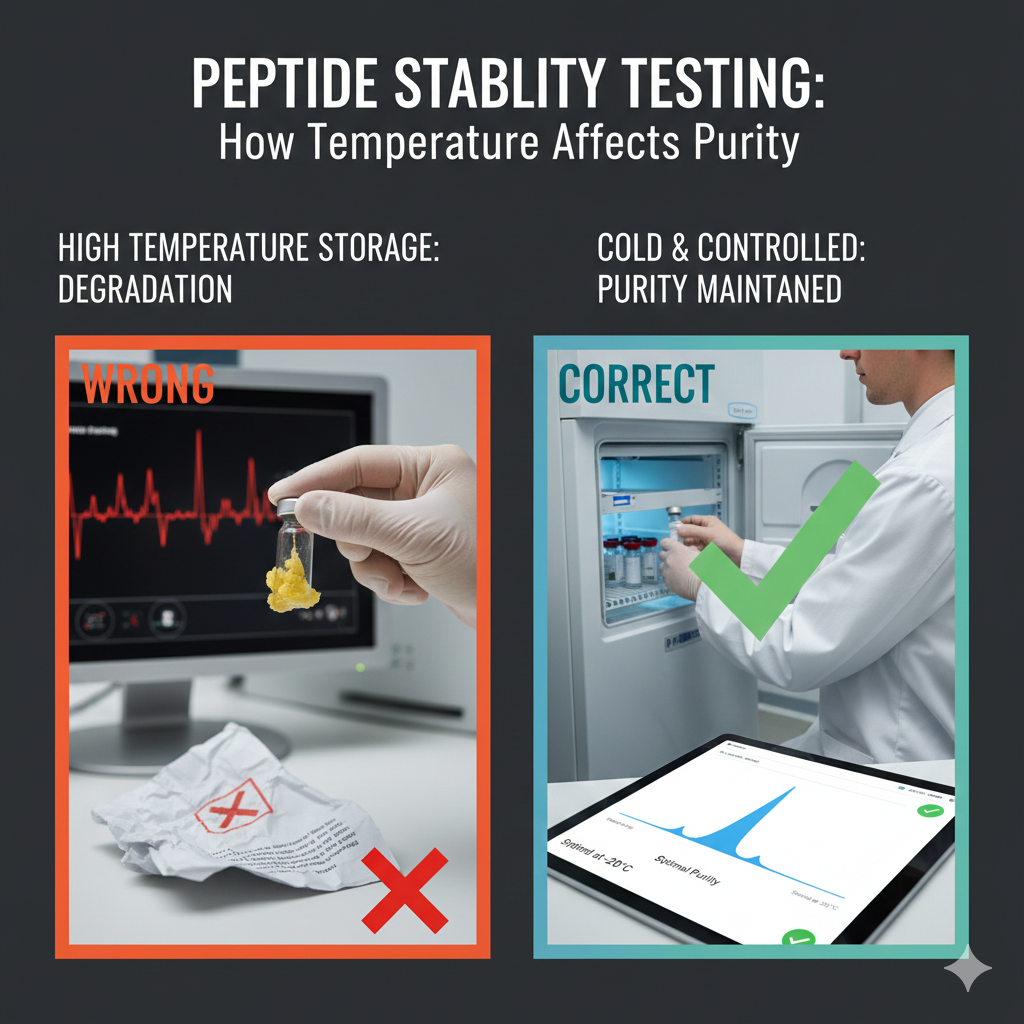
Temperature acts as a catalyst for chemical reactions that break down peptide bonds and alter molecular structures. When peptides are exposed to temperatures above their stability threshold, hydrolysis begins to accelerate, causing the peptide chains to fragment into shorter sequences or individual amino acids. Peptide oxidation represents another temperature-dependent degradation pathway where amino acids like methionine and cysteine undergo irreversible chemical changes that destroy biological activity.
Exponential Degradation Rates at Higher Temperatures
Research shows that for every 10-degree Celsius increase in storage temperature, the degradation rate of most peptides approximately doubles. This exponential relationship means that peptides stored at room temperature degrade significantly faster than those kept in refrigerated or frozen conditions. Understanding freeze thaw cycles peptides experience during improper handling helps researchers avoid the cumulative damage that occurs when compounds repeatedly transition between frozen and liquid states.
What to Look for in Peptides When Assessing Quality
Physical Appearance and Consistency Standards
Quality peptides should arrive in their proper physical state, typically as lyophilized peptides appearing as white or off-white powder that looks uniform throughout the vial. The first thing researchers should examine is the physical appearance, checking for any discoloration, clumping, or unusual texture that might indicate degradation or contamination. High-purity freeze dried peptides maintain a consistent appearance and dissolve clearly when reconstituted with the appropriate solvent.
Certificate of Analysis Documentation Requirements
A peptide certificate of analysis represents the most critical quality indicator that reputable suppliers always provide with every order. These COA peptide documents should detail the purity percentage, typically above 95% for research-grade compounds, along with mass spectrometry data confirming the correct molecular weight and net peptide content. When evaluating what to look for in peptides, always verify that the supplier can provide third party peptide testing results rather than relying solely on in-house quality claims.
How to Test Peptides for Purity at Home
Simple Reconstitution Testing Methods
While comprehensive purity testing requires laboratory equipment, researchers can perform preliminary assessments using several accessible methods. The reconstitution test offers valuable insights into peptide quality by observing how the lyophilized powder dissolves in bacteriostatic water for peptides or sterile saline solution. Pure peptides should dissolve completely within minutes of gentle swirling, creating a clear solution without visible particles or cloudiness that would indicate impurities.
pH Testing and Solution Monitoring Techniques
pH testing strips provide another home-based assessment tool, as most peptides should produce solutions with pH values between 3 and 7 when properly reconstituted. Significant deviations from this range may indicate contamination or degradation products affecting the solution's acidity. Understanding the difference between sterile water vs bacteriostatic water peptides helps researchers choose the appropriate solvent, as bacteriostatic water contains benzyl alcohol that prevents bacterial growth during extended storage periods after reconstitution.
Professional Laboratory Testing Methods
HPLC Analysis for Precise Purity Measurements
Professional peptide testing companies like Optima Labs employ High-Performance Liquid Chromatography (HPLC) as the gold standard for purity analysis. This technique separates peptide molecules based on their chemical properties, allowing technicians to identify and quantify the target peptide alongside any impurities or degradation products. HPLC analysis also detects residual TFA in peptides, as trifluoroacetic acid used during synthesis can remain in final products and affect both purity measurements and biological activity if present in excessive amounts.
Mass Spectrometry and Amino Acid Sequencing
Mass spectrometry complements HPLC testing by confirming the exact molecular weight of compounds present in the sample. This verification ensures that the peptide matches its expected structure and hasn't undergone modifications during synthesis or storage. Third party peptide testing through independent laboratories provides unbiased verification that gives researchers confidence in their compound quality, especially when comparing suppliers or investigating unexpected experimental results that might stem from purity issues.
How to Know if Peptides Are Contaminated
Visual Contamination Indicators to Watch For
Contamination manifests through several observable indicators that researchers should recognize immediately. Visual signs include unexpected color changes, with pure peptides turning yellow, brown, or developing other discolorations that signal bacterial growth or chemical contamination. If reconstituted peptides develop cloudiness or visible floating particles after initially appearing clear, this strongly suggests microbial contamination or the presence of insoluble impurities affecting solution quality.
Odor and Texture Changes Signaling Problems
Unusual odors represent another red flag that shouldn't be ignored when assessing peptide integrity. While lyophilized peptides typically have minimal scent, strong chemical odors or foul smells indicate possible bacterial contamination or the presence of residual synthesis byproducts. Changes in solution viscosity also warrant concern, as contaminated peptides may produce unexpectedly thick or gel-like solutions that differ from the typical clear, water-like consistency of pure peptide solutions prepared correctly.
Storage Temperature Guidelines for Maximum Stability
Optimal Freezer Storage Conditions
Lyophilized peptides achieve maximum stability when stored at temperatures between -20°C and -80°C in a dedicated freezer with minimal temperature fluctuations. This frozen storage significantly slows degradation reactions, extending peptide shelf life to allow properly packaged compounds to maintain their purity for two to three years. Desiccants should always accompany stored peptides to prevent moisture absorption, as even trace humidity can accelerate degradation at any storage temperature.
Refrigerated Storage for Reconstituted Solutions
Once reconstituted, peptides become significantly more vulnerable to degradation and require immediate refrigeration at 2-8°C. Reconstituted solutions typically remain stable for four to six weeks when kept at these temperatures, though stability varies considerably depending on the specific peptide sequence. Never store reconstituted peptides at room temperature for extended periods, as this rapidly accelerates hydrolysis and peptide oxidation reactions that destroy peptide integrity within days or even hours.
Peptide Shelf Life and Expiration Factors
Do Peptides Expire and How Long Do They Last
Understanding peptide expiration timelines helps researchers plan experiments and avoid working with degraded compounds. Properly stored lyophilized peptides can maintain stability for two to three years when kept frozen at -20°C or below, though some sequences remain viable even longer under optimal conditions. Peptide shelf life depends heavily on amino acid composition, with sequences containing oxidation-prone residues or aggregation-prone structures degrading faster than stable linear peptides.
Factors That Shorten Peptide Longevity
Several factors dramatically reduce how long peptides last beyond the standard expiration guidelines. Repeated freeze thaw cycles peptides experience during improper storage can reduce viable shelf life by months or even years, as each temperature transition causes incremental structural damage. Exposure to light, oxygen, and moisture all accelerate degradation pathways that shorten peptide expiration timelines, making proper packaging and storage protocols essential for maximizing compound longevity.
Reconstitution and Handling Best Practices
Proper Temperature Acclimation Before Opening
The reconstitution process itself can impact peptide stability if not performed correctly under temperature-controlled conditions. Always allow frozen peptides to reach room temperature naturally before opening the vial, as temperature shock from immediate reconstitution can cause moisture condensation that dilutes the peptide unpredictably. Choosing between bacteriostatic water for peptides versus sterile water depends on intended usage timeframes, with bacteriostatic water being preferable for solutions stored longer than a few days.
Sterile Technique and Gentle Mixing Protocols
Handle reconstituted peptides with clean technique throughout their usage period to prevent introducing contaminants that thrive at warmer temperatures. Never shake peptide solutions vigorously, as this mechanical stress can damage peptide bonds and reduce purity over time. Instead, gently swirl or roll the vial between your palms to achieve complete dissolution while minimizing molecular stress and maintaining solution integrity throughout the peptide shelf life.
Common Peptide Storage Mistakes to Avoid
Temperature-Related Storage Errors
Many researchers unknowingly make peptide storage mistakes that dramatically shorten compound viability and compromise experimental results. Storing peptides in frost-free freezers represents one of the most damaging errors, as these appliances cycle temperatures regularly to prevent ice buildup, subjecting peptides to harmful freeze thaw cycles. Room temperature storage of lyophilized peptides, even for short periods during shipping or handling, accelerates degradation exponentially compared to continuous frozen storage.
Reconstitution and Handling Mistakes
Improper solvent selection ranks among the most common peptide storage mistakes affecting reconstituted solutions. Using sterile water vs bacteriostatic water peptides without considering storage duration leads to bacterial contamination in solutions stored beyond 48 hours. Another critical error involves reconstituting entire peptide vials when only small amounts are needed, as this forces researchers to repeatedly access the same solution and introduces contamination risks with each use.
How to Check Peptide Purity Through Visual Inspection
Pre-Reconstitution Powder Assessment
Visual inspection serves as the first line of defense in identifying potential purity problems with peptide compounds. Examining the lyophilized powder before reconstitution reveals important clues about handling and storage history. Pure peptides present as uniform, fine powders without crystallization patterns, hard clumps, or cake-like formations that suggest exposure to temperature fluctuations or moisture during shipping and storage.
Post-Reconstitution Clarity Evaluation
The reconstitution process itself offers valuable purity indicators that trained observers can identify immediately. When adding solvent to high-purity peptides, the powder should dissolve smoothly without foaming excessively or leaving residue on the vial walls. Solutions should achieve complete clarity within five to ten minutes of gentle mixing, with no persistent cloudiness or floating particles that indicate impurities or degradation products affecting solubility.
Signs Your Peptides Have Degraded
Reduced Solubility and Dissolution Problems
Degraded peptides often exhibit reduced solubility compared to their fresh counterparts, requiring longer dissolution times or leaving visible residue even after extended mixing. This decreased solubility occurs because degradation fragments have different chemical properties than intact peptides, often forming aggregates that resist dissolution in standard reconstitution solvents. If previously reliable peptides suddenly require excessive mixing time or produce cloudy solutions, degradation has likely compromised their molecular integrity.
Color Changes and Precipitation Events
Changes in solution color provide another clear degradation indicator that shouldn't be dismissed as insignificant. While fresh peptide solutions typically appear colorless or slightly opalescent, degraded samples may develop yellow, amber, or brown tints indicating peptide oxidation products or Maillard reactions between amino acids and reducing sugars. Precipitation of solid material from previously clear solutions represents an advanced degradation stage where peptide fragments have aggregated into insoluble complexes.
Choosing a Reliable Peptide Testing Company
Evaluating Laboratory Credentials and Capabilities
When researching where to buy peptide testing services, evaluating analytical capabilities and quality assurance protocols becomes essential. Reputable laboratories maintain accreditation from recognized bodies and employ validated testing methods that meet international pharmaceutical standards. Companies offering third party peptide testing should readily provide detailed information about their testing equipment, methodology, and quality control procedures without requiring extensive follow-up questions.
Cost Considerations and Service Quality
Understanding peptide testing cost helps researchers budget appropriately while ensuring they receive comprehensive analysis. Prices typically range from fifty to several hundred dollars per sample depending on the complexity of testing requested, with basic HPLC purity analysis being more affordable than comprehensive characterization including mass spectrometry and amino acid analysis. When evaluating how much does peptide testing cost, consider that thorough analysis from certified laboratories like Optima Labs represents a worthwhile investment.
Final Thoughts
Temperature management represents the single most important factor in maintaining peptide purity from synthesis through final use. Understanding how temperature affects peptide stability, recognizing common peptide storage mistakes, and knowing peptide shelf life expectations empowers researchers to make informed decisions. Whether conducting preliminary home assessments or utilizing professional laboratory testing services, systematic evaluation of peptide quality protects research investments.
The relationship between temperature and peptide purity underscores why proper handling protocols cannot be treated as optional suggestions. Every temperature excursion, every moment at room temperature, and every freeze thaw cycle contributes to cumulative degradation that steadily reduces purity levels and shortens peptide expiration timelines. By implementing rigorous temperature control and partnering with qualified testing companies offering third party peptide testing like Optima Labs, researchers maximize compound stability.
Frequently Asked Questions
How do you test the purity of peptides?
Peptide purity testing primarily relies on High-Performance Liquid Chromatography (HPLC), which separates the target peptide from impurities based on chemical properties and quantifies each component's concentration. Mass spectrometry complements HPLC by confirming the molecular weight matches the expected peptide structure. Professional testing companies analyze samples using both techniques to provide comprehensive purity certificates showing percentages typically ranging from 95% to 99% for research-grade peptides. Third party peptide testing through independent laboratories offers unbiased verification, while home researchers can perform preliminary assessments by observing reconstitution behavior and solution clarity.
What should peptides look like?
Lyophilized peptides should appear as fine, white to off-white powders with uniform consistency throughout the vial. The powder should have a light, fluffy texture without hard clumps, crystallization patterns, or cake-like formations that indicate moisture exposure or temperature problems. When reconstituted with appropriate solvents like bacteriostatic water for peptides, pure compounds dissolve completely to form clear, colorless solutions within minutes of gentle mixing. Any discoloration, cloudiness, or visible particles in either the powder or reconstituted solution suggests degradation or contamination that compromises peptide quality.
How can you tell if peptides are fake?
Fake or counterfeit peptides often lack proper documentation, arriving without a peptide certificate of analysis or with suspicious COA peptide documents containing generic data that doesn't match the specific product. Physical red flags include unusual colors, odors, or textures that differ from legitimate lyophilized peptides, along with packaging inconsistencies like missing batch numbers or expiration dates. The most reliable verification method involves sending samples to independent laboratories offering third party peptide testing services like Optima Labs for HPLC and mass spectrometry analysis that confirms molecular identity, purity, and net peptide content.
How long do peptides last in the fridge?
Reconstituted peptides stored in refrigerators at 2-8°C typically remain stable for four to six weeks, though peptide shelf life varies significantly based on the specific sequence and storage conditions. Peptides containing oxidation-prone amino acids like methionine or cysteine may degrade faster, while more stable sequences can maintain purity for up to eight weeks under optimal refrigeration. Always use bacteriostatic water for peptides intended for extended refrigerated storage, as this antimicrobial agent prevents bacterial growth. Understanding how long peptides last after reconstitution helps researchers plan experiments without wasting valuable compounds.
Do peptides expire?
Yes, peptides do expire, though peptide expiration timelines vary based on storage conditions and amino acid composition. Properly stored lyophilized peptides can maintain stability for two to three years when kept frozen at -20°C or colder, while some sequences remain viable even longer. Peptide shelf life decreases dramatically once reconstituted, with solutions typically expiring within four to six weeks when refrigerated. Common peptide storage mistakes like exposure to room temperature, repeated freeze thaw cycles, or improper packaging accelerate expiration by promoting degradation pathways including peptide oxidation and hydrolysis.
What is the difference between sterile water and bacteriostatic water for peptides?
Sterile water contains only purified water free from microorganisms but lacks antimicrobial preservatives, making it suitable only for immediate single-use applications. Bacteriostatic water for peptides contains 0.9% benzyl alcohol, which prevents bacterial growth and allows reconstituted solutions to remain stable for several weeks when refrigerated. When choosing sterile water vs bacteriostatic water peptides, researchers planning to use reconstituted solutions over multiple days should always select bacteriostatic water to prevent contamination. However, sterile water remains preferable for peptides that will be used immediately or that may be sensitive to benzyl alcohol.
How much does peptide testing cost?
Peptide testing cost varies depending on the complexity and type of analysis requested, with basic HPLC purity testing typically ranging from fifty to one hundred fifty dollars per sample. Comprehensive characterization including mass spectrometry, amino acid analysis, and additional quality control tests can cost between two hundred and five hundred dollars per sample. When researching where to buy peptide testing services, consider that prices from certified laboratories offering third party peptide testing represent worthwhile investments compared to the cost of failed experiments from working with degraded or contaminated compounds.