Table of Contents
-
Understanding Why Peptide Testing Matters
-
How to Test Peptides: The Foundation of Quality Assurance
-
Reading Your Peptide Certificate of Analysis
-
HPLC: The Industry Standard for Peptide Purity Testing
-
What to Look for in Peptides When Using HPLC Analysis
-
LC-MS: Advanced Detection for Complex Peptide Verification
-
How to Know if Peptides Are Contaminated Using Mass Spectrometry
-
NMR Spectroscopy: The Gold Standard for Structural Verification
-
Understanding Synthetic Peptide Impurities and Degradation Products
-
How to Check Peptide Purity Across Different Testing Methods
-
Additional Quality Tests: Sterility, Endotoxin, and Water Content
-
Research Grade vs Pharmaceutical Grade Peptides
-
Comparing Cost and Accessibility of Testing Methods
-
Which Testing Method Should You Choose for Your Peptides
-
The Future of Peptide Quality Control
-
Final Thoughts
-
Frequently Asked Questions
Understanding Why Peptide Testing Matters
The Growing Importance of Quality Control in Peptide Research
The peptide industry has experienced explosive growth over recent years, with researchers and consumers alike seeking high-quality compounds for various applications. However, this rapid expansion has introduced significant quality control challenges. Without proper testing, peptides may contain impurities, degradation products, or incorrect sequences that compromise their effectiveness and safety. Understanding the available testing methods becomes essential for anyone working with these compounds, whether in research laboratories or quality assurance roles.
Building Confidence Through Comprehensive Testing
Quality verification serves as the cornerstone of peptide reliability. When peptides arrive from manufacturers without proper certification, users face uncertainty about what they're actually receiving. This uncertainty can lead to failed experiments, wasted resources, and potentially serious safety concerns. Comprehensive testing protocols help establish confidence in peptide identity, purity, and structural integrity before these compounds reach their intended applications.
How to Test Peptides: The Foundation of Quality Assurance
Understanding the Multifaceted Approach to Peptide Analysis
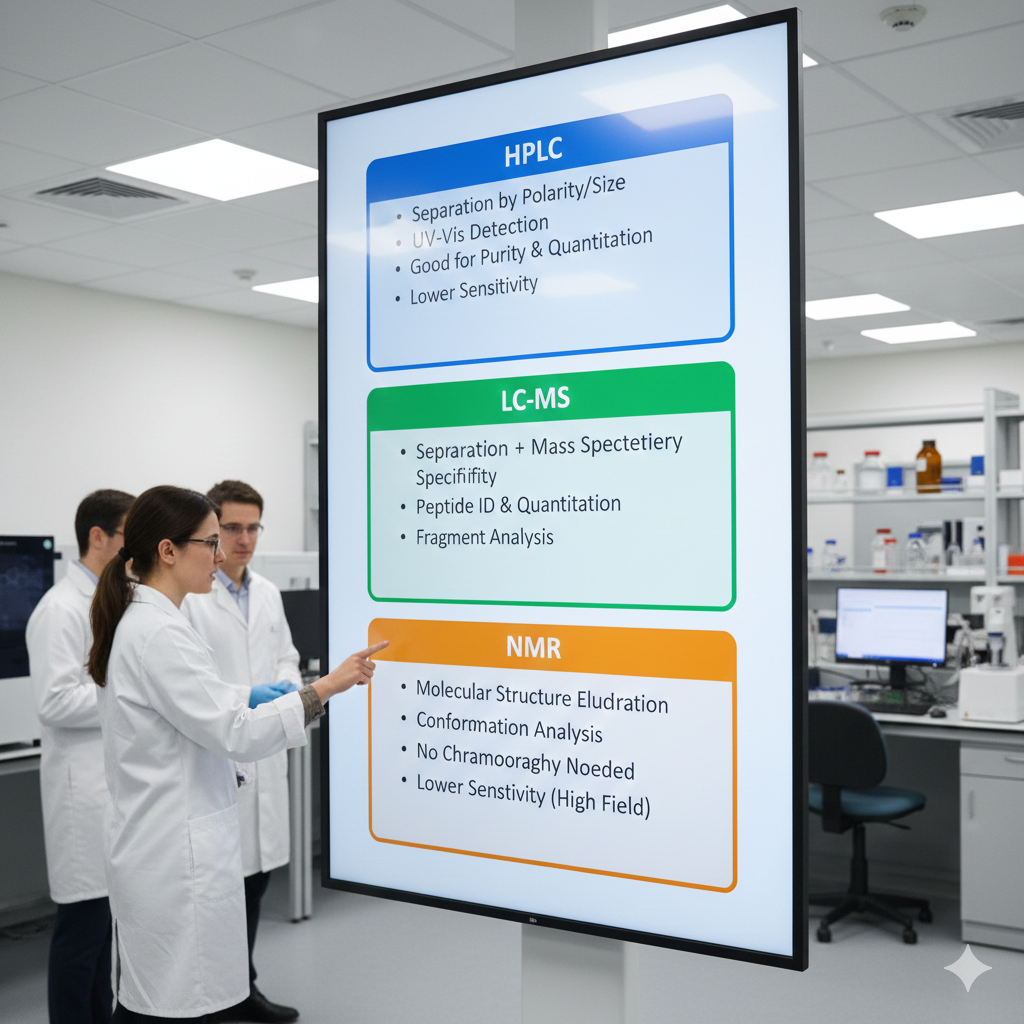
Testing peptides requires a multifaceted approach that examines different aspects of the compound's properties. The primary goal involves confirming that the peptide matches its intended sequence, contains minimal impurities, and maintains proper structural characteristics. Modern analytical chemistry offers several sophisticated techniques, each providing unique insights into peptide quality. The three most prominent methods include High-Performance Liquid Chromatography, Liquid Chromatography-Mass Spectrometry, and Nuclear Magnetic Resonance spectroscopy.
Why Multiple Testing Methods Work Better Together
Each testing methodology addresses specific quality parameters. Some techniques excel at separating and quantifying components in a mixture, while others provide detailed molecular structure information. Professional testing laboratories typically employ multiple methods to create a comprehensive quality profile. This layered approach ensures that potential issues don't slip through the cracks of a single analytical technique's limitations. Peptide sequence verification often requires combining chromatographic and spectroscopic data for complete confidence.
Reading Your Peptide Certificate of Analysis
What Information Should a Peptide CoA Include
A comprehensive peptide certificate of analysis serves as the quality passport for your compound. This document should include HPLC purity data showing the percentage of target peptide versus impurities. Peptide molecular weight confirmation through mass spectrometry verifies correct synthesis and sequence identity. The certificate should also specify net peptide content, which accounts for counterions and water content. Without these critical data points, assessing whether a peptide meets your experimental requirements becomes nearly impossible.
Understanding Net Peptide Content Calculations
Net peptide content represents the actual amount of pure peptide in your vial after accounting for TFA content, water content, and other counterions. Many researchers overlook this specification, leading to dosing errors in their experiments. A vial labeled as containing ten milligrams might only contain seven milligrams of actual peptide, with the remainder consisting of trifluoroacetic acid salts and absorbed moisture. Reputable suppliers provide this information clearly on their certificates of analysis.
Verifying Peptide Reference Standards and Batch Numbers
Quality certificates should include peptide reference standards used during testing and specific batch numbers for traceability. These details enable you to verify results independently and ensure consistency across multiple orders. If your supplier cannot provide detailed certificates with verifiable testing data, this raises serious questions about their quality control processes. Legitimate testing facilities maintain strict documentation standards that support scientific reproducibility.
HPLC: The Industry Standard for Peptide Purity Testing
How HPLC Separates and Quantifies Peptide Components
High-Performance Liquid Chromatography stands as the most widely adopted technique for peptide purity assessment. This method separates peptide mixtures by passing them through a column packed with specialized materials. Different components travel through the column at varying speeds based on their chemical properties, creating distinct peaks on a chromatogram. The separation quality depends on factors like column type, mobile phase composition, and flow rate settings.
Measuring Purity Through Chromatographic Analysis
HPLC excels at quantifying the target peptide relative to impurities and degradation products. Most peptide manufacturers provide certificates of analysis showing HPLC purity percentages, typically ranging from 95% to 99% for high-quality products. The technique operates relatively quickly, with most analyses completing within 30 to 60 minutes. This efficiency makes HPLC ideal for routine quality control in production environments where throughput matters significantly.
Why HPLC Remains the Most Accessible Testing Method
The accessibility of HPLC technology contributes to its widespread adoption. Many laboratories already own HPLC systems for other analytical work, reducing barriers to implementation. Operating costs remain moderate compared to more advanced techniques, though consumables like columns and solvents represent ongoing expenses. Skilled technicians can run multiple samples per day, making this approach economically viable for regular testing programs.
What to Look for in Peptides When Using HPLC Analysis
Interpreting Chromatogram Peaks for Quality Assessment
Interpreting HPLC results requires understanding what constitutes acceptable quality parameters. The main peptide peak should dominate the chromatogram, ideally accounting for 95% or more of the total peak area. Smaller peaks represent synthetic peptide impurities, which may include truncated sequences, deletion peptides, or starting materials from synthesis. The presence and size of these impurity peaks provide crucial quality insights that inform decisions about peptide usability.
Reading Peak Shapes to Detect Structural Issues
Peak shape offers additional information beyond simple purity percentages. Sharp, symmetrical peaks indicate homogeneous peptides with consistent properties. Broad or asymmetric peaks might suggest structural heterogeneity or peptide degradation products forming during storage or handling. Experienced analysts also examine retention times, comparing them against reference standards to verify peptide identity. Significant deviations from expected retention times raise red flags about possible identification errors or composition problems.
Understanding Method Parameters and Their Impact on Results
Beyond the chromatogram itself, method details matter considerably. Different HPLC conditions can yield varying purity values for the same peptide sample. Reputable testing providers specify their method parameters, including column type, gradient conditions, and detection wavelength. This transparency allows for meaningful comparisons between different test results and ensures reproducibility across multiple analyses.
LC-MS: Advanced Detection for Complex Peptide Verification
Combining Separation Power with Molecular Weight Confirmation
Liquid Chromatography-Mass Spectrometry combines HPLC's separation power with mass spectrometry's identification capabilities. After separation by liquid chromatography, compounds enter a mass spectrometer that measures their mass-to-charge ratios. This dual approach provides both purity information and peptide molecular weight confirmation in a single analysis. The mass data helps verify that the peptide possesses the correct amino acid sequence and expected molecular formula.
Detecting Sequence Errors Through Mass Analysis
Mass spectrometry excels at detecting subtle differences between closely related peptides. Even single amino acid substitutions produce measurable mass changes, allowing LC-MS to catch sequence errors that might escape other methods. The technique also identifies specific impurities by their unique mass signatures, providing detailed contamination profiles. This specificity proves invaluable when investigating quality issues or validating synthetic processes through peptide sequence verification.
Leveraging High Sensitivity for Precious Samples
Modern LC-MS instruments offer impressive sensitivity, detecting peptides at nanogram or even picogram levels. This capability enables analysis of precious samples where limited quantities exist. High-resolution mass spectrometers can distinguish between compounds with very similar masses, resolving ambiguities that lower-resolution instruments might miss. These advanced capabilities come at a cost, both in equipment investment and operational complexity.
How to Know if Peptides Are Contaminated Using Mass Spectrometry
Identifying Contamination Through Unexpected Mass Signals
Mass spectrometry reveals contamination through multiple indicators in the resulting spectra. Unexpected mass peaks signal the presence of compounds other than the target peptide. Common contaminants include salts, solvents, truncated sequences, and synthesis byproducts. Each contaminant produces characteristic mass signals that trained analysts can identify. The relative intensities of these signals indicate contamination severity and help assess whether the peptide meets quality specifications.
Diagnosing Contamination Sources from Mass Patterns
Specific contamination patterns provide clues about their origins. For example, peptides containing multiple sodium or potassium adducts suggest inadequate desalting during purification. Peaks corresponding to deletion sequences indicate incomplete synthesis or degradation. Oxidation products appear as mass increases of 16 daltons per oxidized residue. Recognizing these patterns helps laboratories diagnose quality control issues and implement corrective measures in production processes.
Detecting TFA Content and Counterion Issues
Trifluoroacetic acid in peptides represents one of the most common contamination concerns. While TFA serves as a useful reagent during peptide synthesis and purification, residual TFA content affects net peptide content calculations and can interfere with certain biological assays. Mass spectrometry readily detects TFA-related peaks, helping quantify this contaminant. Understanding your peptide's counterion composition ensures accurate experimental dosing and prevents unexpected assay interference.
NMR Spectroscopy: The Gold Standard for Structural Verification
Understanding How NMR Reveals Molecular Structure
Nuclear Magnetic Resonance spectroscopy provides the most comprehensive structural information available for peptide characterization. This technique exploits the magnetic properties of atomic nuclei, particularly hydrogen and carbon atoms. When placed in a strong magnetic field and exposed to radiofrequency pulses, these nuclei produce signals that reveal detailed information about molecular structure, including atom connectivity, stereochemistry, and conformational preferences.
Verifying Complete Structural Integrity
NMR analysis confirms not just the amino acid sequence but also the precise arrangement of atoms within the peptide. This level of detail enables detection of structural anomalies like incorrect stereochemistry, unusual modifications, or unexpected folding patterns. For peptides with disulfide bonds or other structural constraints, NMR verifies proper formation of these critical features. This comprehensive structural validation surpasses what chromatographic or mass spectrometric methods can achieve alone.
Navigating the Limitations of NMR Analysis
The primary limitations of NMR involve sample requirements and accessibility. Obtaining high-quality NMR spectra typically requires larger sample quantities than HPLC or LC-MS, often several milligrams of pure peptide. The analysis also demands considerable time, with complete structural elucidation potentially taking several hours or even days. Additionally, NMR instruments represent substantial capital investments, and data interpretation requires specialized expertise that many laboratories lack.
Understanding Synthetic Peptide Impurities and Degradation Products
Common Types of Synthetic Peptide Impurities
Synthetic peptide impurities arise from various sources during the manufacturing process. Deletion sequences occur when one or more amino acids fail to couple during synthesis, creating shorter peptide variants. Truncation products result from incomplete synthesis or premature chain termination. Diastereomers form when amino acids incorporate with incorrect stereochemistry. Each impurity type presents unique analytical challenges and may require different testing approaches for detection and quantification.
How Peptide Degradation Products Form Over Time
Peptide degradation products develop through chemical reactions after synthesis, particularly during storage or handling. Oxidation of methionine and cysteine residues represents the most common degradation pathway, especially when peptides encounter air or light exposure. Deamidation of asparagine and glutamine residues occurs gradually in aqueous solutions. Disulfide bond scrambling affects peptides containing multiple cysteine residues. Understanding these degradation mechanisms helps implement appropriate storage conditions and stability testing protocols.
Using Amino Acid Analysis to Identify Impurities
Peptide amino acid analysis provides orthogonal verification of peptide composition and can reveal certain impurities that other methods miss. This technique involves hydrolyzing the peptide into individual amino acids, then quantifying each residue. Deviations from the expected amino acid ratios indicate composition problems, incomplete synthesis, or specific degradation pathways. While amino acid analysis destroys the sample, it offers definitive composition data that supports other analytical findings.
How to Check Peptide Purity Across Different Testing Methods
Integrating HPLC Data as Your Primary Purity Metric
Evaluating peptide purity comprehensively requires integrating information from multiple analytical techniques. HPLC provides the primary purity value, expressed as a percentage of the main peak relative to all detected peaks. This number offers a straightforward quality metric that most users can readily understand and compare. However, HPLC alone cannot confirm that the main peak actually contains the correct peptide or reveal certain types of contamination.
Adding Mass Spectrometry for Identity Confirmation
LC-MS adds a critical verification layer by confirming molecular weight. A peptide showing 98% purity by HPLC should also display the expected mass in the mass spectrum. Discrepancies between HPLC purity and mass spectrometry results warrant further investigation. For instance, the main HPLC peak might contain the correct peptide plus a closely related impurity with similar retention time but different mass. Such scenarios highlight why multiple orthogonal methods provide more reliable quality assessment.
Using NMR for Definitive Structural Validation
NMR verification becomes particularly important for peptides with complex structures or critical stereochemistry. While more resource-intensive, NMR analysis eliminates ambiguity about structural correctness that other methods leave unresolved. For research applications where peptide structure directly impacts experimental outcomes, this investment in comprehensive characterization pays dividends through experimental reliability. Commercial peptide suppliers increasingly offer multi-method testing packages that combine these complementary approaches.
Additional Quality Tests: Sterility, Endotoxin, and Water Content
Why Peptide Sterility Testing Matters for Cell Culture
Peptide sterility testing becomes essential when compounds will be used in cell culture, tissue engineering, or any biological system sensitive to microbial contamination. Standard sterility testing follows pharmacopeial methods, incubating peptide samples in growth media designed to support bacteria and fungi. Clean peptides show no microbial growth after the incubation period. This testing proves particularly critical for peptides used in clinical research or therapeutic development where contamination could compromise patient safety.
Understanding Peptide Endotoxin Testing Requirements
Peptide endotoxin testing detects bacterial endotoxins that can trigger powerful immune responses even at extremely low concentrations. The Limulus Amebocyte Lysate test represents the gold standard for endotoxin detection, measuring down to picogram levels. Researchers working with immune cells or conducting in vivo studies must verify low endotoxin levels in their peptides. Even peptides synthesized under clean conditions may accumulate endotoxins during handling or storage in non-sterile environments.
Measuring Peptide Water Content for Accurate Dosing
Peptide water content significantly affects accurate experimental dosing and net peptide content calculations. Lyophilized peptides typically contain between 5% and 15% residual water by weight, though highly hygroscopic peptides may absorb even more moisture from air. Karl Fischer titration provides the most accurate water content measurement. Failing to account for water content leads to systematic dosing errors that can invalidate experimental results, particularly in studies requiring precise concentration control.
Research Grade vs Pharmaceutical Grade Peptides
Understanding Quality Tier Differences
Research grade peptides typically meet purity specifications between 75% and 95%, suitable for preliminary studies, assay development, and non-critical applications. These products cost less but may contain higher levels of synthetic peptide impurities and degradation products. Pharmaceutical grade peptides exceed 98% purity with rigorous testing including peptide sterility testing, peptide endotoxin testing, and comprehensive impurity profiling. The additional quality control justifies higher costs for clinical research and therapeutic development.
When to Invest in Higher Grade Peptides
Selecting appropriate peptide grades depends on experimental sensitivity and downstream applications. Routine screening studies and educational demonstrations often perform adequately with research grade materials. However, mechanistic studies, structure-activity relationships, and dose-response experiments require pharmaceutical grade peptides to ensure results reflect true peptide activity rather than impurity effects. Clinical research and regulatory submissions mandate pharmaceutical grade peptides with complete documentation and batch-to-batch consistency.
Documentation and Traceability Requirements
Pharmaceutical grade peptides come with comprehensive certificates of analysis detailing every quality parameter. These documents provide peptide reference standards, specific testing methods, acceptance criteria, and batch traceability information. Research grade peptides may offer limited documentation, sometimes providing only basic HPLC purity data. The documentation difference becomes critical when experimental results require publication, patent applications, or regulatory review where complete analytical characterization proves necessary.
Comparing Cost and Accessibility of Testing Methods
HPLC: The Most Economical Option for Routine Testing
Budget considerations significantly influence testing strategy selection for many organizations. HPLC analysis typically costs between $100 and $300 per sample through commercial testing laboratories, making it the most economical option for routine quality control. Most mid-sized research institutions possess HPLC equipment, enabling in-house testing that further reduces per-sample costs. The technique's widespread availability ensures quick turnaround times and easy access to qualified service providers.
LC-MS: Balancing Cost with Enhanced Information
LC-MS testing generally runs higher, with prices ranging from $200 to $500 per sample depending on the analysis depth required. The increased cost reflects more sophisticated instrumentation and the specialized expertise needed for data interpretation. However, the additional information obtained often justifies the expense, particularly when peptide molecular weight confirmation proves essential. Some laboratories offer tiered pricing where basic LC-MS screening costs less than comprehensive characterization packages.
NMR: Premium Testing for Critical Applications
NMR spectroscopy represents the premium testing option, with costs frequently exceeding $500 to $1,000 per sample for complete structural analysis. These higher prices stem from expensive instrumentation, lengthy analysis times, and the need for highly trained specialists. NMR testing typically gets reserved for critical applications like final product release testing, regulatory submissions, or research where structural certainty cannot be compromised. For routine quality checks on commercial peptides, the cost-benefit ratio often favors HPLC or LC-MS instead.
Which Testing Method Should You Choose for Your Peptides
Selecting Methods Based on Application Requirements
Selecting appropriate testing methods depends on specific application requirements and quality concerns. For general research use where manufacturer certificates already provide HPLC data, independent verification through HPLC or LC-MS offers reasonable assurance. If experiments yield unexpected results or quality seems questionable, more comprehensive LC-MS or NMR analysis helps identify potential issues. Novel peptides without established analytical data benefit from thorough multi-method characterization initially.
Meeting Regulatory Standards for Pharmaceutical Development
Regulatory applications demand the highest level of analytical rigor. Pharmaceutical development programs typically require comprehensive testing including HPLC purity, peptide molecular weight confirmation through LC-MS, and often NMR structural verification. These stringent requirements ensure that therapeutic peptides meet safety and efficacy standards before advancing to clinical testing. Even non-pharmaceutical regulatory contexts may specify particular testing methods in their guidance documents.
Implementing a Tiered Testing Strategy for Cost Efficiency
Cost-conscious users might implement a tiered testing strategy. Initial screening through HPLC identifies obviously problematic samples at minimal expense. Samples passing HPLC screening then undergo LC-MS confirmation to verify identity and detect hidden impurities. Only peptides for critical applications or those showing ambiguous results in preliminary tests proceed to NMR analysis. This approach balances thoroughness with budgetary constraints while maintaining appropriate quality standards.
The Future of Peptide Quality Control
Emerging Technologies Expanding Analytical Capabilities
Emerging technologies continue advancing peptide testing capabilities. Novel chromatography phases provide enhanced separation of closely related peptides, improving HPLC resolution and purity discrimination. Advanced mass spectrometry techniques like ion mobility spectrometry add another dimension of molecular characterization, distinguishing between structural isomers that conventional LC-MS cannot resolve. These innovations gradually expand the analytical toolbox available for quality assessment and peptide sequence verification.
Automation and AI Transforming Laboratory Workflows
Automation and artificial intelligence are transforming how laboratories process and interpret analytical data. Automated sample preparation systems reduce human error and increase throughput for high-volume testing programs. Machine learning algorithms help identify complex contamination patterns and predict potential quality issues based on spectral features. These technological advances promise faster, more reliable testing at reduced costs as they mature and gain wider adoption.
Miniaturization Making Testing More Accessible
Miniaturization trends may eventually make sophisticated testing more accessible. Microfluidic devices performing chromatographic separations or mass spectrometric analysis could bring lab-quality testing to point-of-use scenarios. While still largely in development, such technologies might one day enable researchers to verify peptide quality directly in their own laboratories without specialized equipment or extensive training. This democratization of analytical chemistry would significantly impact the peptide industry's quality landscape.
Final Thoughts
Peptide testing represents an essential investment in research quality and safety. The three primary methods—HPLC, LC-MS, and NMR—each offer distinct advantages for different aspects of quality verification. HPLC provides accessible, cost-effective purity assessment suitable for routine applications. LC-MS adds crucial peptide molecular weight confirmation and contamination identification capabilities. NMR delivers comprehensive structural validation when absolute certainty becomes necessary. Understanding these complementary techniques empowers researchers and quality professionals to make informed decisions about peptide verification strategies.
Comprehensive quality assessment extends beyond simple purity measurements. Evaluating synthetic peptide impurities, peptide degradation products, water content, and potential contaminants like trifluoroacetic acid in peptides creates a complete quality profile. For sensitive applications, additional testing including peptide sterility testing and peptide endotoxin testing ensures biological safety. Reading your peptide certificate of analysis carefully and understanding net peptide content prevents common experimental errors.
At Optima Labs, we recognize that quality testing forms the foundation of reliable peptide research and application. Our comprehensive analytical services help ensure that your peptides meet the highest standards of purity and identity. Whether you need basic HPLC screening or complete multi-method characterization including peptide amino acid analysis and peptide sequence verification, proper testing protocols safeguard your work against the costly consequences of contaminated or mislabeled compounds.
Frequently Asked Questions
How do you test the purity of a peptide?
Peptide purity testing primarily uses High-Performance Liquid Chromatography, which separates the target peptide from impurities based on chemical properties. The resulting chromatogram shows peaks for each component, with the main peptide peak's area compared to total peak area to calculate purity percentage. Most high-quality peptides show purity values above 95%. Additional confirmation through LC-MS verifies that the main peak contains the correct molecular weight, ensuring the identified compound matches the intended peptide sequence. Complete purity assessment should also consider net peptide content, accounting for water content and counterions.
What is the best method for peptide analysis?
No single method serves as universally "best" for all peptide analysis situations. HPLC offers the most practical balance of cost, speed, and information for routine quality control. LC-MS provides superior identification capabilities and contamination detection for critical applications requiring peptide molecular weight confirmation. NMR delivers the most comprehensive structural information but requires more time and resources. The optimal approach often combines multiple methods, using HPLC for initial purity assessment followed by LC-MS for peptide sequence verification and NMR when applications demand higher certainty about peptide structure.
How do you test peptide concentration?
Peptide concentration testing commonly employs UV spectroscopy, measuring absorbance at specific wavelengths (typically 280 nm for peptides containing aromatic amino acids). The measured absorbance relates to concentration through the Beer-Lambert law, using extinction coefficients calculated from amino acid composition. Alternative methods include peptide amino acid analysis, which quantifies individual amino acids after peptide hydrolysis, and quantitative NMR using internal standards. HPLC with calibration curves using peptide reference standards also enables accurate concentration determination. Always account for water content and TFA content when calculating net peptide content for experimental dosing.
What is the HPLC method for peptides?
HPLC methods for peptides typically use reversed-phase chromatography with C18 or C8 columns. The mobile phase consists of water and acetonitrile or methanol, both containing small amounts of trifluoroacetic acid to improve peak shape. Analysis runs gradient elution programs that gradually increase organic solvent concentration, causing peptides to elute at characteristic retention times. Detection occurs through UV absorbance monitoring, usually at 214 nm or 220 nm where peptide bonds absorb light. Method parameters require optimization for specific peptides to achieve adequate resolution between the target compound and synthetic peptide impurities.
How to check if peptide is real?
Verifying peptide authenticity requires confirming both identity and purity through analytical testing. LC-MS provides the most definitive identity confirmation through peptide molecular weight confirmation, which must match the theoretical value calculated from the peptide sequence. HPLC retention time comparison against peptide reference standards offers supporting evidence. For suspicious samples, complete peptide amino acid analysis or NMR spectroscopy can definitively establish whether the compound matches the claimed structure. Reviewing the peptide certificate of analysis for comprehensive testing data and purchasing from reputable suppliers significantly reduces the risk of receiving counterfeit or mislabeled peptides.
What does peptide testing show?
Comprehensive peptide testing reveals multiple quality parameters essential for research and application success. Purity testing through HPLC shows the percentage of target peptide versus synthetic peptide impurities, peptide degradation products, and synthesis byproducts. Peptide molecular weight confirmation via mass spectrometry confirms correct sequence and detects modifications. Peptide sequence verification through LC-MS or peptide amino acid analysis ensures proper composition. Structural analysis through NMR verifies stereochemistry and disulfide bond formation. Additional tests assess net peptide content, water content, TFA content, and for sensitive applications, peptide sterility testing and peptide endotoxin testing ensure biological safety.
What is peptide certificate of analysis?
A peptide certificate of analysis (CoA) is an official document provided by peptide suppliers that details all quality testing results for a specific batch. The certificate should include HPLC purity data, peptide molecular weight confirmation from mass spectrometry, net peptide content calculations accounting for water content and counterions, and specific batch numbers for traceability. Quality certificates may also report peptide sterility testing results, peptide endotoxin testing data, and information about peptide reference standards used during analysis. This documentation proves essential for experimental reproducibility and becomes critical when publishing research or pursuing regulatory applications requiring pharmaceutical grade peptides.