Table of Contents
-
Understanding HPLC Testing for Peptides
-
Why Peptide Purity Matters More Than You Think
-
How to Test Peptides Using High-Performance Liquid Chromatography
-
What to Look for in Peptides When Reading Test Results
-
The Science Behind HPLC Peptide Analysis
-
How to Know if Peptides Are Contaminated
-
Reading Your HPLC Certificate: A Practical Guide
-
How to Check Peptide Purity Before Purchase
-
Common Impurities Found in Peptide Products
-
Peptide Storage and Stability: Maintaining Quality Over Time
-
Mass Spectrometry vs HPLC: Understanding the Difference
-
Red Flags in Peptide Testing Reports
-
Final Thoughts on Peptide Quality Verification
-
Frequently Asked Questions
Understanding HPLC Testing for Peptides
What Makes HPLC the Gold Standard
High-Performance Liquid Chromatography, commonly known as HPLC, represents the gold standard in peptide purity testing. This analytical technique separates, identifies, and quantifies different components within a peptide sample, providing researchers and consumers with reliable data about what they're actually getting in their vials. Unlike simpler testing methods that might only confirm the presence of a peptide, HPLC testing reveals the complete picture of your product's composition, including any unwanted substances that might compromise its effectiveness or safety. Every reputable supplier provides a certificate of analysis peptides documentation that includes HPLC data, making this the primary tool for peptide quality control.
Why HPLC Testing Has Become Essential
The importance of HPLC testing has grown exponentially as the peptide research market has expanded. With more suppliers entering the space and varying quality standards across manufacturers, understanding how to test peptides has become essential knowledge for anyone serious about research applications. HPLC doesn't just tell you whether a peptide is present; it quantifies exactly how much of your product is the actual target peptide versus impurities, degradation products, or other unwanted compounds. Proper peptide batch testing ensures consistency across different production runs and helps maintain research reproducibility.
Why Peptide Purity Matters More Than You Think
Impact on Research Outcomes and Safety
Peptide purity directly impacts research outcomes, safety profiles, and the reliability of any data generated from experiments. When you purchase a peptide advertised as 98% pure, that two percent difference might seem negligible, but those impurities can significantly alter results. Lower purity peptides contain higher concentrations of synthesis byproducts, truncated sequences, or deletion peptides that can interfere with receptor binding, cellular uptake, or biological activity. Understanding the distinction between research grade peptides and lower quality alternatives becomes crucial when planning experiments that demand precision.
The Importance of Consistency and Reproducibility
Research applications demand consistency and reproducibility. Using peptides with unknown or varying purity levels introduces variables that make it impossible to draw meaningful conclusions from studies. This becomes particularly critical in dose-dependent research where precise concentrations are essential. A peptide testing report showing 95% purity means that five percent of your product consists of something other than your target compound, which could include related peptides with similar structures but different biological activities, salts, solvents, or actual contaminants. The concept of net peptide content takes this further by accounting for all non-peptide components including salts, water, and counterions that contribute to the total weight but not to biological activity.
Financial Implications of Purity Levels
The financial implications of purity also deserve consideration. When you calculate dosing based on total weight but your product is only 85% pure, you're effectively underdosing by fifteen percent. Over time, this discrepancy compounds, affecting both experimental consistency and cost-effectiveness. Understanding what to look for in peptides regarding purity specifications helps ensure you're getting actual value for your investment.
How to Test Peptides Using High-Performance Liquid Chromatography
Sample Preparation and Injection Process
The HPLC testing process begins with sample preparation, where a small amount of peptide is dissolved in an appropriate solvent. This solution is then injected into the HPLC system, which consists of several key components working in concert. The mobile phase, typically a mixture of water and organic solvents like acetonitrile, carries the sample through a column packed with specialized stationary phase material.
The Separation Mechanism Explained
As the peptide solution travels through the column, different components separate based on their chemical properties. The target peptide and any impurities interact differently with the stationary phase, causing them to move through the column at different rates. This separation is the heart of how HPLC works. A detector at the column's end measures the compounds as they exit, typically using UV absorbance at specific wavelengths where peptides naturally absorb light.
Understanding the Chromatogram Output
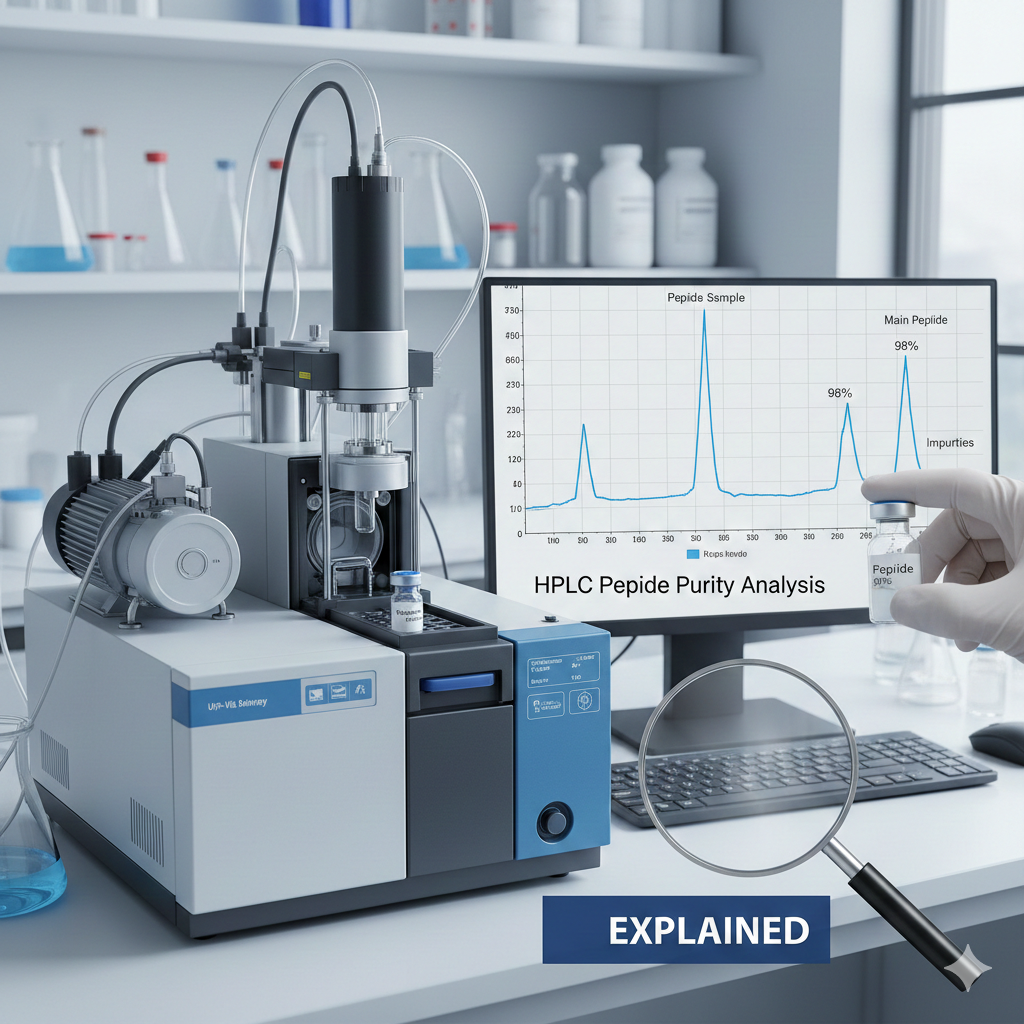
The resulting data appears as a chromatogram, essentially a graph showing detector response over time. The target peptide appears as a distinct peak, with its area under the curve proportional to its concentration. Smaller peaks represent impurities, and their relative sizes compared to the main peak indicate purity levels. Modern HPLC systems can detect impurities at levels below one percent, making this method exceptionally sensitive for quality control purposes.
What to Look for in Peptides When Reading Test Results
Key Elements in HPLC Certificates
When examining an HPLC certificate of analysis, several key elements deserve attention. The main peak's retention time should match expected values for your specific peptide, confirming you've received the correct compound. The purity percentage, calculated as the area of the main peak divided by the total area of all peaks, tells you how much of your product is actually the target peptide.
Evaluating Peak Shape and Quality
Peak shape provides additional insights into peptide quality. A sharp, symmetrical peak suggests high quality and proper synthesis, while broad or asymmetric peaks might indicate degradation, aggregation, or synthesis issues. The baseline between peaks should be relatively flat and stable; excessive noise or drift can suggest analytical problems or high levels of minor impurities not resolved into distinct peaks.
Understanding Integration Parameters
Integration parameters matter significantly when evaluating purity claims. Some suppliers manipulate how peaks are integrated to inflate purity numbers. Look for reports that show the full chromatogram with clearly marked integration boundaries. The method should integrate all peaks above a reasonable threshold, not just the major components. Reports showing only a zoomed-in view of the main peak without revealing the full baseline raise red flags about what might be hidden in the data.
The Science Behind HPLC Peptide Analysis
How Reversed Phase HPLC Works
HPLC separates compounds based on differential interactions between molecules and the stationary phase. For peptide analysis, reversed phase HPLC peptides methodology is most common, using a nonpolar stationary phase and a polar mobile phase. Peptides interact with the column based on their hydrophobicity, with more hydrophobic peptides retained longer and eluting later in the run. This reversed phase technique has become the industry standard because it provides excellent resolution for most peptide sequences and is compatible with mass spectrometry detection.
The Mobile Phase Gradient System
The mobile phase typically starts with high water content and gradually increases the organic solvent concentration through a programmed gradient. This gradient elution allows separation of compounds with varying hydrophobicity levels. As the organic content increases, even strongly retained peptides eventually elute from the column, ensuring complete sample analysis within a reasonable timeframe.
Detection Methods and Sensitivity
Detection relies on peptides' natural ability to absorb ultraviolet light, particularly at wavelengths around 214 to 220 nanometers where the peptide bond absorbs strongly. This universal detection method works for virtually all peptides regardless of sequence, though some amino acids with aromatic side chains provide additional absorbance at higher wavelengths like 280 nanometers. The detector's response is proportional to peptide concentration, enabling quantitative analysis.
How to Know if Peptides Are Contaminated
Synthesis-Related Impurities
Identifying contaminated peptides requires understanding what contaminants might be present and how they appear in analytical results. Synthesis-related impurities include truncated sequences missing one or more amino acids, deletion peptides with internal amino acid deletions, and peptides with incomplete protecting group removal. These appear as separate peaks in HPLC chromatograms, typically eluting near but not at the same retention time as the target peptide. Understanding peptide synthesis impurities helps researchers interpret chromatograms more effectively and recognize quality issues.
Bacterial and Endotoxin Contamination
Bacterial or endotoxin contamination presents a different challenge since these substances don't show up in standard HPLC analysis. Comprehensive testing should include endotoxin testing peptides protocols using methods like the Limulus Amebocyte Lysate assay, particularly for peptides intended for any application involving cells or biological systems. High endotoxin levels can trigger inflammatory responses that confound research results or create safety concerns. Many suppliers now offer third party tested peptides with independent verification of endotoxin levels, providing additional quality assurance.
Chemical Contaminants and Visual Indicators
Chemical contaminants might include residual solvents from synthesis or purification, salts from buffer systems, or trifluoroacetic acid commonly used in peptide purification. While HPLC can detect some of these contaminants, others require additional analytical techniques. Amino acid analysis peptides testing provides orthogonal confirmation of peptide composition and can help identify unexpected amino acid ratios that suggest contamination or synthesis errors. A brown or yellow discoloration in lyophilized peptides often indicates oxidation or other degradation, suggesting improper storage or old product. Fresh, high-quality peptides typically appear as white or off-white powders.
Reading Your HPLC Certificate: A Practical Guide
Essential Certificate Components
A legitimate HPLC certificate should include several essential elements that together provide a complete picture of peptide quality. The header identifies the peptide by name, sequence, molecular weight, and batch number, allowing you to verify you're examining results for the specific product you received. The methodology section describes the HPLC conditions used, including column type, mobile phase composition, gradient program, flow rate, detection wavelength, and injection volume.
Interpreting the Chromatogram Data
The chromatogram itself forms the heart of the certificate, displaying time on the x-axis and detector response on the y-axis. Look for a clear, well-resolved main peak without excessive shouldering or splitting, which could indicate multiple closely related peptides. The purity calculation should be clearly stated, typically shown as a percentage with the calculation method specified. Integration parameters and peak identification should be transparent.
Additional Verification Data
Additional data strengthens confidence in results. Some certificates include mass spectrometry data confirming the molecular weight matches theoretical expectations for your peptide sequence. Amino acid analysis provides orthogonal confirmation of sequence and composition. The certificate should be dated and signed by a qualified analyst, with contact information for the testing laboratory. Certificates lacking these elements or showing only partial chromatograms deserve skepticism.
How to Check Peptide Purity Before Purchase
Request Batch-Specific Certificates
Before committing to a peptide purchase, requesting and reviewing certificates of analysis for specific batches provides crucial quality assurance. Reputable suppliers readily provide these documents for current inventory, not just generic certificates from old batches. The certificate should match the batch number of the product you'll receive, ensuring the data reflects what you're actually buying.
Compare Claims Against Actual Data
Compare purity claims in marketing materials against actual certificate data. A supplier advertising 99% purity should provide certificates documenting purity at or above this level. Be wary of vague claims like "high purity" or "research grade" without specific percentages backed by analytical data. These terms lack standardized definitions and might mask lower-quality products.
Consider Third-Party Verification
Third-party testing offers additional verification, particularly for high-value peptides or critical applications. Some researchers send samples to independent analytical laboratories for confirmation testing, especially when working with new suppliers. While this adds cost and time, it provides unbiased verification of quality claims. The investment often proves worthwhile given the potential consequences of using low-quality peptides in important research.
Common Impurities Found in Peptide Products
Truncated Sequences
Understanding typical impurities helps interpret HPLC results and assess overall peptide quality. Truncated sequences, missing one or more amino acids from the N-terminus or C-terminus, rank among the most common synthesis-related impurities. These form when coupling reactions fail to go to completion during solid-phase synthesis. Truncated peptides often retain similar chromatographic properties to the target compound, appearing as peaks close to the main peak.
Deletion Peptides
Deletion peptides lack one or more internal amino acids while maintaining the correct N-terminus and C-terminus. These arise from repeated coupling at sites where a previous coupling failed, creating sequences with gaps. Depending on which amino acids are missing, deletion peptides might have significantly different retention times or might co-elute with the target, making them harder to detect.
Oxidation Products and Modifications
Oxidation products appear when peptides containing methionine or cysteine residues undergo oxidation during synthesis, purification, or storage. These modified peptides typically show different retention times from the target compound. Aggregated or cyclized peptides form through unwanted peptide bond formation or disulfide bridge creation, creating peaks with altered retention times.
TFA and Salt Content Issues
The presence of TFA in peptides, specifically trifluoroacetate counterions from purification processes, can constitute a substantial portion of lyophilized powder weight without appearing in HPLC chromatograms. This trifluoroacetic acid peptides issue effectively reduces the actual peptide content per milligram, which is why understanding net peptide content becomes critical for accurate dosing calculations.
Peptide Storage and Stability: Maintaining Quality Over Time
Proper Storage Conditions for Lyophilized Peptides
Proper peptide storage and stability management directly affects the quality and purity measurements discussed throughout HPLC testing. Even a peptide that arrives with excellent purity can degrade if stored incorrectly, rendering initial test results meaningless. Lyophilized peptides should be stored at negative twenty degrees Celsius or colder in desiccated conditions to minimize moisture exposure. Exposure to room temperature, humidity, or repeated freeze-thaw cycles can trigger degradation reactions that create new impurity peaks in subsequent HPLC analysis.
Reconstitution Best Practices
The peptide reconstitution process also impacts stability and apparent purity. Choosing the correct solvent is crucial because some peptides aggregate or precipitate in certain buffers, creating apparent impurities or reducing the amount of soluble, bioavailable peptide. Sterile water works well for many peptides, but others require specific pH buffers or inclusion of organic solvents like DMSO to maintain solubility. Poor reconstitution practices can lead to peptide aggregation, oxidation, or degradation that wouldn't show up in the original certificate of analysis.
Long-Term Storage of Reconstituted Peptides
Once reconstituted, peptide solutions are significantly less stable than lyophilized powder. Most reconstituted peptides should be used within days to weeks even when refrigerated, as hydrolysis and oxidation occur more rapidly in solution. For longer-term storage of reconstituted peptides, aliquoting into single-use portions and freezing at negative eighty degrees Celsius minimizes degradation from repeated freeze-thaw cycles. Researchers conducting peptide solubility testing often discover that proper handling makes the difference between successful experiments and failed studies, regardless of the initial purity level.
Mass Spectrometry vs HPLC: Understanding the Difference
Complementary Techniques for Complete Analysis
While HPLC and mass spectrometry both play crucial roles in peptide analysis, they provide complementary information serving different purposes. HPLC excels at quantifying purity by separating and measuring all components in a mixture, telling you what percentage of your product is the target peptide versus impurities. Mass spectrometry identifies compounds based on their molecular weight, confirming that the main component has the correct mass for your intended sequence. MALDI-TOF mass spectrometry peptides analysis has become particularly popular because it's fast, requires minimal sample preparation, and provides accurate molecular weight determination for peptide verification.
Why Both Methods Are Necessary
A peptide might pass mass spectrometry analysis by showing the correct molecular weight peak while failing purity assessment through HPLC because it contains significant impurities. Conversely, HPLC might show high purity without confirming that the main peak actually represents the correct peptide sequence. This is why comprehensive peptide characterization uses both techniques together rather than relying on either alone.
Detecting Sequence Variations and Modifications
Mass spectrometry proves particularly valuable for detecting subtle sequence variations or modifications that might not separate well by HPLC. Post-translational modifications, amino acid substitutions, or incorrect synthesis can yield peptides with different molecular weights detectable by mass spectrometry even when chromatographic properties closely match the target compound. The combination of HPLC purity data with mass spectrometry identity confirmation provides robust quality assurance for research applications.
Red Flags in Peptide Testing Reports
Incomplete or Manipulated Chromatograms
Several warning signs in testing documentation should raise concerns about peptide quality or supplier integrity. Certificates showing only a small portion of the chromatogram without the full run from injection to end suggest potential manipulation, hiding additional peaks that would reduce calculated purity. The baseline before and after the main peak should be visible to demonstrate complete separation and proper integration.
Generic or Missing Documentation
Generic certificates not specific to your batch number indicate the supplier might not actually test every batch, instead recycling old certificates. This practice leaves you uncertain about the quality of your specific product. Certificates lacking essential information like analysis date, analyst signature, testing laboratory details, or methodology descriptions lack the credibility needed for serious research applications.
Unrealistic Purity Claims and Pricing
Suspiciously perfect results, such as claims of 99.9% purity or higher, merit scrutiny. While achievable, such high purity typically requires extensive purification and comes at premium prices. Budget peptides rarely achieve purity above 98%, and claims otherwise suggest either exceptional value or inaccurate reporting. Pricing significantly below market rates for claimed purity levels often indicates quality concerns worth investigating before purchase.
Final Thoughts on Peptide Quality Verification
Verifying peptide quality through proper HPLC testing represents an essential step in research integrity and experimental success. Understanding how to interpret analytical certificates, recognize quality indicators, and identify red flags empowers researchers to make informed purchasing decisions. The time invested in evaluating supplier documentation and testing protocols prevents far larger investments of time and resources that would be wasted using low-quality peptides yielding unreliable or irreproducible results. Whether working with standard research grade materials or GMP grade peptides for more stringent applications, the principles of quality verification remain consistent.
As the peptide research market continues expanding, maintaining high analytical standards becomes increasingly important. Demand for transparency in testing, batch-specific certificates, and comprehensive characterization pushes the industry toward better quality control practices. Researchers who prioritize quality verification contribute to this positive trend while protecting their own work from the compromises that come with contaminated or impure peptides. The growing availability of third party tested peptides provides additional confidence for critical research applications.
The knowledge to properly evaluate peptide purity empowers better research outcomes. Whether working with commercially available peptides or custom synthesis, applying these principles to quality assessment ensures your research builds on a foundation of reliable, well-characterized materials. The extra diligence in verification always proves worthwhile when compared to the alternative of discovering quality issues only after results fail to replicate or experiments yield confusing data.
Frequently Asked Questions
What does HPLC purity percentage actually mean?
HPLC purity percentage represents the proportion of your peptide product that is the target compound versus all other detectable substances in the sample. This number is calculated by measuring the area under the main peptide peak in the chromatogram and dividing it by the total area of all peaks detected during the analysis. For example, 95% purity means that 95% of the peptide content is your target sequence, while the remaining 5% consists of impurities like truncated peptides, deletion sequences, or other synthesis byproducts. However, this percentage only accounts for peptide-related compounds and does not include non-peptide content like salts, water, or residual solvents that might be present in the lyophilized powder.
How accurate is HPLC testing for peptides?
HPLC testing is highly accurate for peptide purity determination when performed correctly using validated methods and proper instrumentation. Modern HPLC systems can detect impurities at levels below 0.1%, making them sensitive enough for quality control applications requiring high purity standards. The accuracy depends on several factors including proper column selection, appropriate mobile phase composition, optimized gradient conditions, and correct detector settings. When laboratories follow Good Manufacturing Practice guidelines and regularly calibrate equipment, HPLC provides reproducible results with accuracy typically within 1-2% of true values. For critical applications, running samples in duplicate or triplicate and using internal standards further improves accuracy and confidence in reported purity values.
Can HPLC detect all types of peptide contamination?
HPLC effectively detects peptide-related impurities like truncated sequences, deletion peptides, and other synthesis byproducts that have different chromatographic properties from the target compound. However, HPLC has limitations in detecting certain contaminants. Bacterial contamination, endotoxins, and microorganisms do not show up in standard HPLC analysis and require separate testing methods like LAL assays or bioburden testing. Some salts and small molecule impurities might not absorb UV light at the detection wavelength used for peptides, making them invisible in HPLC chromatograms. Additionally, HPLC cannot distinguish between different peptides with identical retention times, so closely related sequences might co-elute and appear as a single peak. This is why comprehensive peptide characterization often includes multiple analytical techniques beyond just HPLC.
What is the difference between HPLC and UPLC for peptide testing?
UPLC, or Ultra-Performance Liquid Chromatography, is an advanced form of HPLC that uses columns packed with smaller particles and operates at higher pressures. This technology provides better resolution, faster analysis times, and improved sensitivity compared to traditional HPLC. For peptide analysis, UPLC can separate closely eluting impurities that might appear as a single peak in conventional HPLC, potentially revealing quality issues not detectable with standard methods. UPLC runs typically complete in 5-10 minutes versus 20-30 minutes for HPLC, increasing laboratory efficiency. However, both techniques measure the same fundamental property of purity by separating and quantifying components in a peptide sample. The choice between HPLC and UPLC depends on the required resolution, available instrumentation, and whether faster analysis or better separation of complex mixtures is needed.
What should I look for in a certificate of analysis peptides document?
A comprehensive certificate of analysis peptides should include multiple elements beyond just HPLC purity data. First, verify the document shows the specific batch number matching your product, the analysis date, and the testing laboratory's accreditation or credentials. The HPLC section should display the full chromatogram from start to finish, not just a zoomed view of the main peak, along with clear integration parameters and purity calculation methodology. Look for additional testing data such as mass spectrometry confirming molecular weight, amino acid analysis verifying composition, and endotoxin testing results if relevant for your application. The certificate should specify net peptide content when applicable, accounting for counterions and moisture content. Finally, check for clarity on storage conditions and expiration dating, as these affect long-term stability and usability of your peptide.
How long does HPLC peptide testing take?
A typical HPLC analysis for peptide purity takes between 20 to 60 minutes for the actual chromatographic run, depending on the gradient program and column conditions used. However, the total time from sample submission to receiving results includes additional steps. Sample preparation might take 15-30 minutes, and if multiple samples are in queue, wait times extend accordingly. Most commercial testing laboratories provide results within 3-7 business days from sample receipt, accounting for analysis time, data review, and certificate generation. For rush analysis, some laboratories offer expedited testing with results in 24-48 hours at premium pricing. Research facilities with in-house HPLC capabilities can often obtain results the same day if prioritized. The run time itself varies based on the specific peptide being analyzed and the method optimization required to achieve adequate separation of the target compound from potential impurities.
Is 95% purity good enough for peptide research?
Whether 95% purity is sufficient depends on your specific research application and requirements. For many basic research applications, 95% purity provides acceptable quality, particularly for initial screening studies or applications where minor impurities do not significantly affect outcomes. However, for dose-response studies, receptor binding assays, or research requiring precise quantification, higher purity peptides of 98% or above are preferable. The 5% impurity content in a 95% pure peptide could include related sequences with similar biological activities that confound results, or inactive truncated peptides that effectively reduce your actual active compound concentration. For in vivo studies or applications involving cells, higher purity becomes more important to minimize potential toxic effects from contaminants or unexpected biological responses from impurity peptides. Critical research, publication-quality studies, or therapeutic development work typically demands peptides with purity above 98% to ensure reproducibility and reliable conclusions.
What should the chromatogram look like for a high-quality peptide?
A high-quality peptide chromatogram displays a single dominant peak that is sharp, symmetrical, and well-resolved from any minor impurity peaks. The main peak should have a Gaussian or near-Gaussian shape without shouldering, splitting, or tailing, indicating good column performance and proper peptide dissolution. The baseline before and after the main peak should be flat and stable, with minimal noise or drift, showing that the separation conditions are appropriate and the detector is functioning correctly. Any impurity peaks present should be small, clearly separated from the main peak, and together constitute less than 2-5% of the total peak area depending on purity specifications. The retention time of the main peak should be consistent with previous analyses of the same peptide and fall within the expected range based on the peptide's hydrophobicity and the chromatographic method used. Poor quality chromatograms showing broad peaks, multiple major peaks, or irregular baselines suggest problems with either the peptide quality or the analytical method.