Table of Contents
-
Why Buying Peptides Online Requires Careful Evaluation
-
Why Most Peptide Buyers Get Misled
-
Purity Claims Without Proof Are Meaningless
-
Why “99% Pure” Often Means Nothing
-
Batch-Specific Certificates of Analysis and Why They Matter
-
The Difference Between Real COAs and Reused Documents
-
Independent Testing and Why It Changes Everything
-
Why Internal Testing Alone Is Not Enough
-
Peptide Identity Confirmation Versus Purity
Why Sequence Errors Are More Common Than You Think -
Understanding Peptide Synthesis Quality
-
How Synthesis Shortcuts Create Long-Term Problems
-
Purification Methods and Their Hidden Limitations
-
Why High Purity Can Still Hide Serious Issues
-
How Peptides Get Contaminated Before You Ever Receive Them
-
Handling, Packaging, and Cross-Contamination Risks
-
Shipping and Storage as Silent Quality Killers
-
Why Peptide Degradation Is Often Misdiagnosed
-
Transparency as a Quality Signal
-
How to Choose a Peptide Supplier Based on Evidence
-
Price Psychology and the Real Cost of Cheap Peptides
-
How to Buy Peptides Safely Without Guesswork
-
Why Testing Is the Only Reliable Truth
-
Final Thoughts: Informed Buyers Protect Research Integrity
-
Frequently Asked Questions About Buying Peptides Online
Why Buying Peptides Online Requires Careful Evaluation
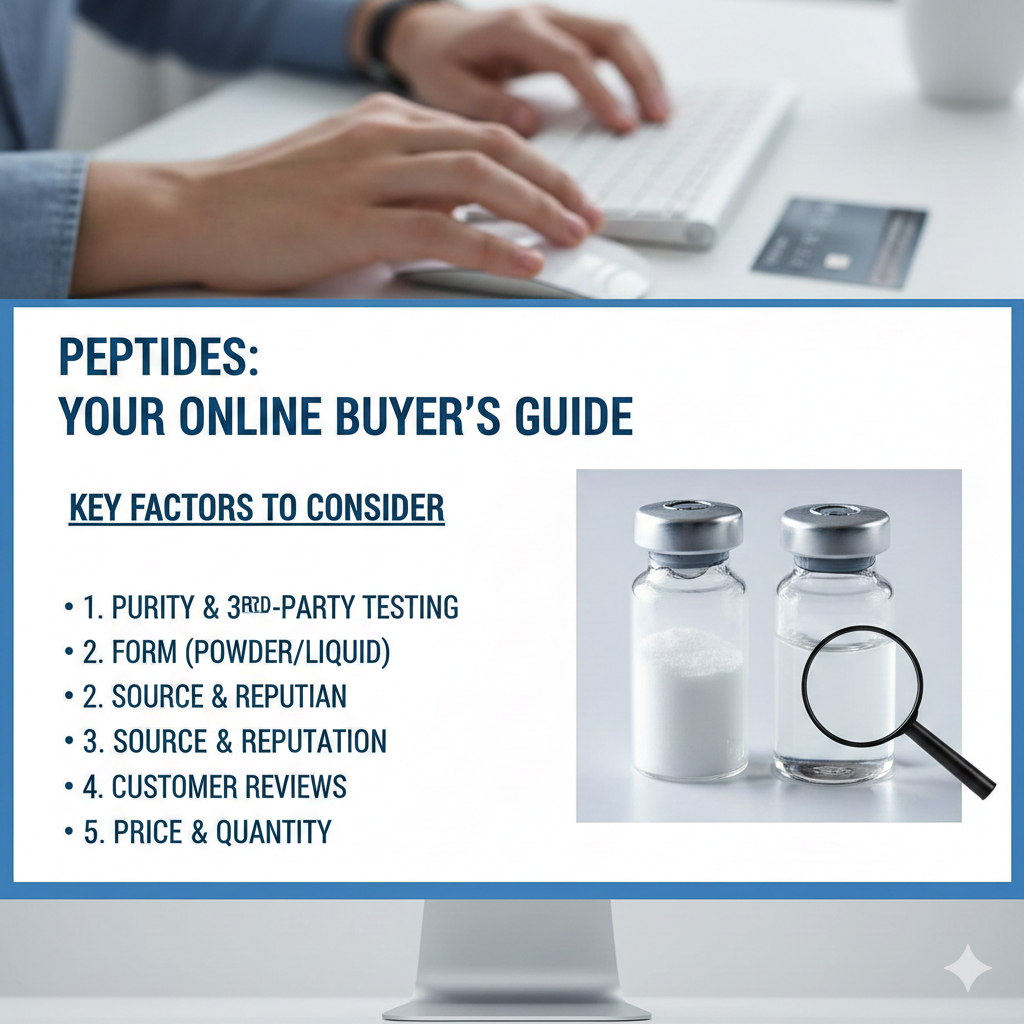
Buying peptides online has become increasingly common, but accessibility has outpaced accountability. Many buyers search for what to look for in peptides before buying online because the market is saturated with sellers making claims that are difficult or impossible to verify. Professional websites, polished branding, and confident purity percentages often create a false sense of security.
The peptide industry operates with minimal regulatory oversight. This means suppliers are largely responsible for acknowledging their own quality standards, and buyers are responsible for determining whether those standards are real. Understanding how to buy peptides safely requires a mindset shift away from trust and toward verification.
Why Most Peptide Buyers Get Misled
Most peptide buyers are misled not because they are careless, but because marketing language is designed to mimic scientific credibility. Terms like “research grade,” “pharmaceutical quality,” and “lab tested” are frequently used without clear definitions or supporting data.
When buyers do not know what to look for in peptides, they rely on surface-level indicators. Unfortunately, these indicators are easy to fabricate. This is why so many people later ask how to know if peptides are contaminated or how to verify peptide quality after encountering unexpected results.
Purity Claims Without Proof Are Meaningless
Purity is one of the most emphasized selling points in the peptide market. Claims of 98% or 99% purity are often displayed prominently, yet few buyers understand how these numbers are generated. Purity percentages depend entirely on the analytical method used, the detection limits of the equipment, and the way results are reported.
Without access to raw analytical data, purity claims are essentially unverifiable. Buyers researching how to check peptide purity must understand that a purity number without context provides no real assurance of quality.
Why “99% Pure” Often Means Nothing
A reported purity percentage does not reveal what the remaining percentage consists of. That remaining fraction could include truncated peptides, synthesis byproducts, residual solvents, or degradation fragments. Some of these impurities can significantly affect research outcomes.
Additionally, purity results may be calculated using selective reporting. Certain impurities may fall below detection thresholds or be excluded from final calculations. This is why understanding what to look for in peptides involves questioning how purity was measured, not just what number was reported.
Batch-Specific Certificates of Analysis and Why They Matter
A Certificate of Analysis is only meaningful if it applies directly to the batch being sold. Batch-specific COAs confirm that the exact material received by the buyer was tested, rather than a similar or previous batch.
Many buyers searching how to know if a peptide supplier is legit discover that some vendors reuse COAs across multiple batches. This practice eliminates traceability and makes verification impossible.
The Difference Between Real COAs and Reused Documents
A real COA includes a unique batch number, testing date, analytical methods used, purity results, and the identity of the testing laboratory. It should be possible to trace this information back to a specific sample.
Reused or generic COAs often lack batch numbers, contain vague testing descriptions, or display inconsistent formatting across different products. These documents are designed to reassure, not verify.
Independent Testing and Why It Changes Everything
Independent testing is one of the strongest indicators of peptide quality. When testing is performed by a third-party laboratory with no financial stake in the result, the data carries far more weight.
Buyers trying to avoid fake peptides often prioritize suppliers who support independent testing. This willingness signals confidence in product quality and a commitment to transparency.
Why Internal Testing Alone Is Not Enough
Internal testing can be useful, but it lacks neutrality. Even well-intentioned internal labs operate under pressure to produce favorable results. This is why relying solely on internal testing increases risk.
Independent testing introduces accountability and reduces the likelihood of selective reporting. For buyers researching how to verify peptide quality, third-party validation is essential.
Peptide Identity Confirmation Versus Purity
Purity alone does not confirm that a peptide is correct. Identity testing verifies that the amino acid sequence matches the intended structure. A peptide can be relatively pure while still being incorrectly synthesized.
Mass spectrometry is commonly used for identity confirmation, yet many suppliers do not disclose whether identity testing has been performed. Buyers who focus only on purity may overlook sequence errors entirely.
Why Sequence Errors Are More Common Than You Think
Peptide synthesis is a stepwise process that involves repeated coupling reactions. Errors can occur at any step, leading to missing, duplicated, or substituted amino acids.
These errors are not always removed during purification. As a result, a peptide may test as highly pure while still being structurally incorrect.
Understanding Peptide Synthesis Quality
Synthesis quality depends on reagent quality, reaction conditions, and operator expertise. Shortcuts during synthesis may reduce cost but increase the likelihood of impurities and sequence errors.
Buyers researching what to look for in peptides should understand that synthesis quality sets the foundation for everything that follows. No amount of purification can fully correct poor synthesis.
How Synthesis Shortcuts Create Long-Term Problems
Cost-driven synthesis shortcuts often result in incomplete reactions or increased byproduct formation. These issues may not be immediately obvious but can compromise reproducibility over time.
Researchers may misinterpret inconsistent results as experimental error rather than peptide quality issues.
Purification Methods and Their Hidden Limitations
Purification methods such as high-performance liquid chromatography are effective but not infallible. Some impurities closely resemble the target peptide and may co-elute during purification.
This means that high purity percentages do not guarantee the absence of problematic contaminants. Buyers asking how to check peptide purity must consider purification limitations alongside reported results.
Why High Purity Can Still Hide Serious Issues
Purity testing often focuses on detecting known impurity types. Unknown or unexpected contaminants may not be detected or reported.
This is why relying on a single testing method is risky. Comprehensive verification requires multiple analytical approaches.
How Peptides Get Contaminated Before You Ever Receive Them
Contamination can occur at multiple stages, including synthesis, purification, handling, packaging, and storage. Many buyers searching how peptides get contaminated assume contamination happens only during synthesis, but this is rarely the full picture.
Cross-contamination between batches, exposure to non-sterile environments, and improper equipment cleaning are common sources of contamination.
Handling, Packaging, and Cross-Contamination Risks
Facilities that process multiple peptides face a constant risk of cross-contamination. Even trace amounts of another peptide can affect sensitive research applications.
Poor handling practices during packaging can introduce endotoxins or particulates that are difficult to detect without specialized testing.
Shipping and Storage as Silent Quality Killers
Shipping and storage conditions play a critical role in peptide stability. Temperature fluctuations, moisture exposure, and light can degrade peptides during transit.
Degradation creates peptide fragments that function as contaminants. This explains why some peptides test pure initially but perform poorly after shipping.
Why Peptide Degradation Is Often Misdiagnosed
Degraded peptides often appear visually unchanged. Without testing, degradation may be mistaken for experimental variability or protocol error.
This leads many researchers to question their methods rather than peptide quality.
Transparency as a Quality Signal
Transparency is one of the clearest indicators of supplier reliability. Transparent suppliers provide detailed information about synthesis, testing methods, limitations, and storage recommendations.
Evasive answers, vague documentation, or excessive marketing language often indicate that verification is lacking.
How to Choose a Peptide Supplier Based on Evidence
Choosing a peptide supplier should be an evidence-based decision. Buyers should evaluate documentation quality, testing transparency, and willingness to support independent verification.
Understanding how to choose a peptide supplier reduces reliance on trust and minimizes risk.
Price Psychology and the Real Cost of Cheap Peptides
Low prices are often interpreted as good deals, but in the peptide market, they frequently signal compromised quality. Shortcuts in synthesis, purification, or testing reduce costs but increase risk.
Researchers looking into how to buy peptides safely recognize that unreliable peptides often cost more in the long run through failed experiments and wasted time.
How to Buy Peptides Safely Without Guesswork
Buying peptides safely requires skepticism, verification, and documentation review. Purity claims, COAs, and marketing language must be supported by real data.
Independent testing remains the most reliable way to confirm peptide quality.
Why Testing Is the Only Reliable Truth
Laboratory testing provides objective evidence that cannot be replaced by visual inspection or supplier claims. Methods such as HPLC and mass spectrometry reveal impurity profiles and confirm identity.
Researchers asking how to test peptides for purity should understand that no shortcut exists. Testing is not optional; it is foundational.
Final Thoughts: Informed Buyers Protect Research Integrity
Knowing what to look for in peptides before buying online empowers researchers to avoid fake peptides, contaminated materials, and unreliable suppliers. In a lightly regulated market, verification is the only safeguard.
When buyers prioritize evidence over claims, they protect both their research and their credibility.
Frequently Asked Questions About Buying Peptides Online
How can I tell if a peptide supplier is legitimate?
A legitimate peptide supplier provides batch-specific Certificates of Analysis, supports independent third-party testing, and clearly explains testing methods and limitations. Generic documentation and vague claims are warning signs.
What should I look for in a peptide Certificate of Analysis?
A valid COA includes the peptide name, batch number, testing date, analytical method used, purity results, and the name of the testing laboratory. Missing batch information or lab identification reduces credibility.
Can peptides look pure but still be low quality?
Yes. Most contaminants and degradation products do not change the appearance of peptides. Only analytical testing can confirm purity and identity.
How do I know if peptides are contaminated?
The only reliable way to know if peptides are contaminated is through laboratory testing such as HPLC and mass spectrometry. Visual inspection and supplier claims are insufficient.
Is it risky to buy peptides online?
Buying peptides online carries risk due to limited regulation. However, understanding how to verify peptide quality and choosing suppliers that support independent testing significantly reduces that risk.